Looking at hallways, I can see not only a path between rooms, I can see a prospect. The ideas of 2026 Highway remodel concerns 2026 are all about transforming these forgotten spaces into useful, beautiful and consistent home components. The idea one is seeking is to remodel a small hallway, remodel upstairs hallway, or brilliant long hallway, but the idea is the same always, to make each square foot work harder without being stressed and still to feel comfortable and beautiful. This paper will step through the practical strategies in the various types of hallways, the logic behind each solution, and what I would personally prioritize in actual projects. I am also going to briefly mention ideas of hallway closet remodel and hallway bathroom remodel ideas, as the issues of storage and access to utilities are usually the largest and most unspoken issues in real homes.
1. Hallway Remodel Ideas 2026: Modern Concepts For Every Home
The way I design ideas of corridor remodel 2026 is to consider the hallway as a room with a purpose, not a by-product of a piece of floor. I prefer setting a visual direction by using uniform flooring, neutral wall colors and smooth trim in such a way that one gets an easy passage between rooms. Hallways are the backbone of the layout in most houses and thus I consider extensively how the lighting, art and doors can form a beat along the backbone. I tend to prefer the neutral walls with the texture – plaster effect paint, slight paneling or wood elements rather than the overcrowded colors that may grow old soon. The method of this kind can make nearly any type of residence, be it modern apartment or old-fashioned home, feel less distant.
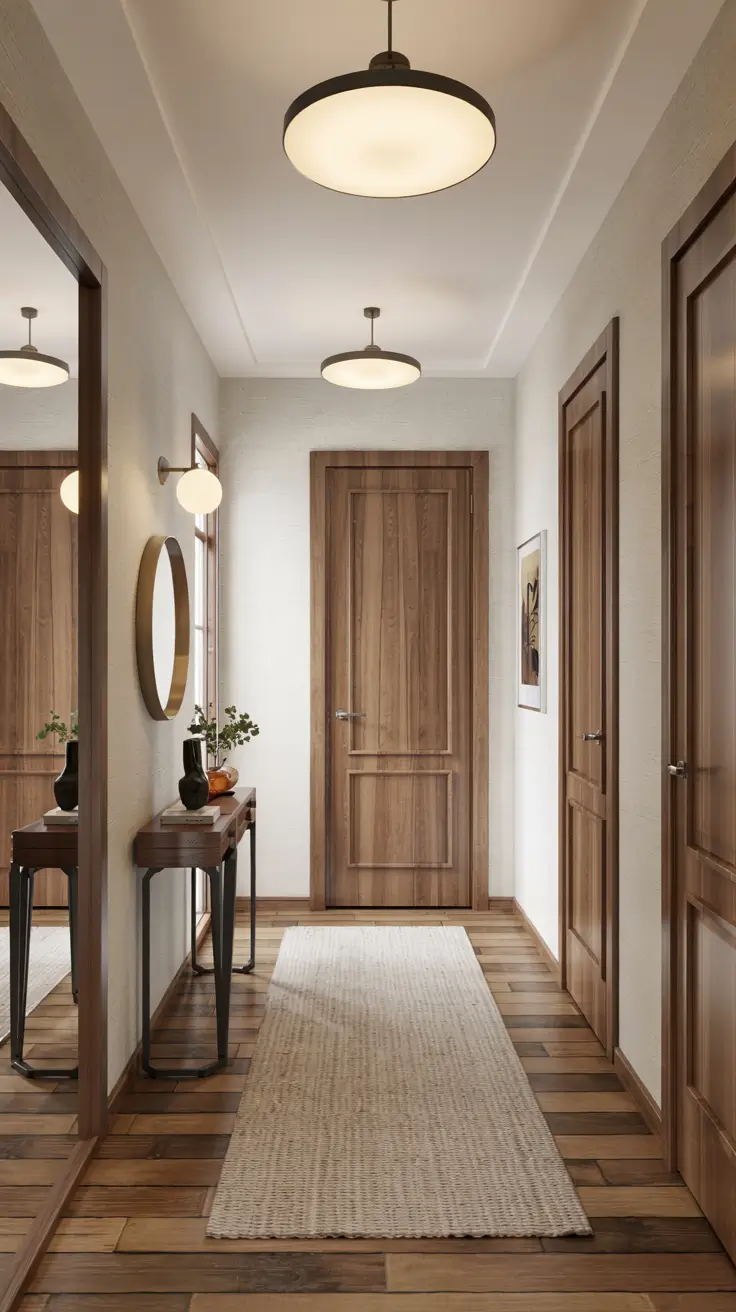
Regarding certain details, I nearly always start with lighting, as the poorly illuminated passageways feel narrow even when they are a large width. I use a series of ceiling lights, either wall lights or both and ensure that the temperature is the same all the way. The second stage that I will carry out is planning surfaces: durable flooring, which needs to interconnect with other rooms, baseboards that are neither too high nor too slim, and doors and hardware with matching profiles. When furniture can be accommodated, I select slim consoles, shallow benches or benches built into the wall that do not interfere with circulation. I also consider what will be placed on the walls – framed artwork, mirrors or plain hooks – and how they will add to an impression of order instead of clutter.
In my opinion, a contemporary corridor is supposed to be purposeful yet not excessive. I regularly refer to the advice of such magazines as Architectural Digest or such design experts as Nate Berkus who highlight the necessity of unity in circulation areas and encourages people to invest in lighting and hardware since those are the areas that humans touch on daily. I concur with that wholly: a plain hallway with pretty door knobs, an overall heavy-feeling hinge and cozy layered lights will always feel luxurious in comparison with a hallway painted with a fashionable paint and with one bright ceiling lamp. My own criteria in test of a scheme is, would a person be able to walk through the area at night or early in the morning and still feel oriented and safe and comfortable.
When a hallway plan appears not to be complete, it tends to lack softness and sound comfort. I would include a low-pile runner rug that is easy to clean yet not too smooth to allow foot traction in case of children or pets in the house. I would also think of replacing any hollow-core interior doors with solid or solid-feel versions, as this would add to the sound control and perceived quality. Lastly, I would include one or two focal moments such as a showpiece work of art, a particular sconce or a striking door color so that the corridor narrates with the other rooms in the house rather than drowning in the background.
2. Transforming Narrow Spaces With Long Hallway Remodel Ideas
I visualize remodel possibilities along long corridors when I think in terms of long corridors and my visualization transforms the corridor into a movie strip instead of a photograph. A long corridor may be experienced as an endless tunnel unless it is varied, therefore I pay attention to making soft visual stops in the passage. My first step is to reduce the visual clutter that can make a small space even smaller by using a uniform color on the walls, uniform flooring, and continuous clean ceilings. Then I seek means to interrupt the line with rhythm and repetition like spaced sconces, framed prints or shallow wall effects. I want to ensure that the walk is an active and enjoyable experience rather than one that people are rushing to get over with.
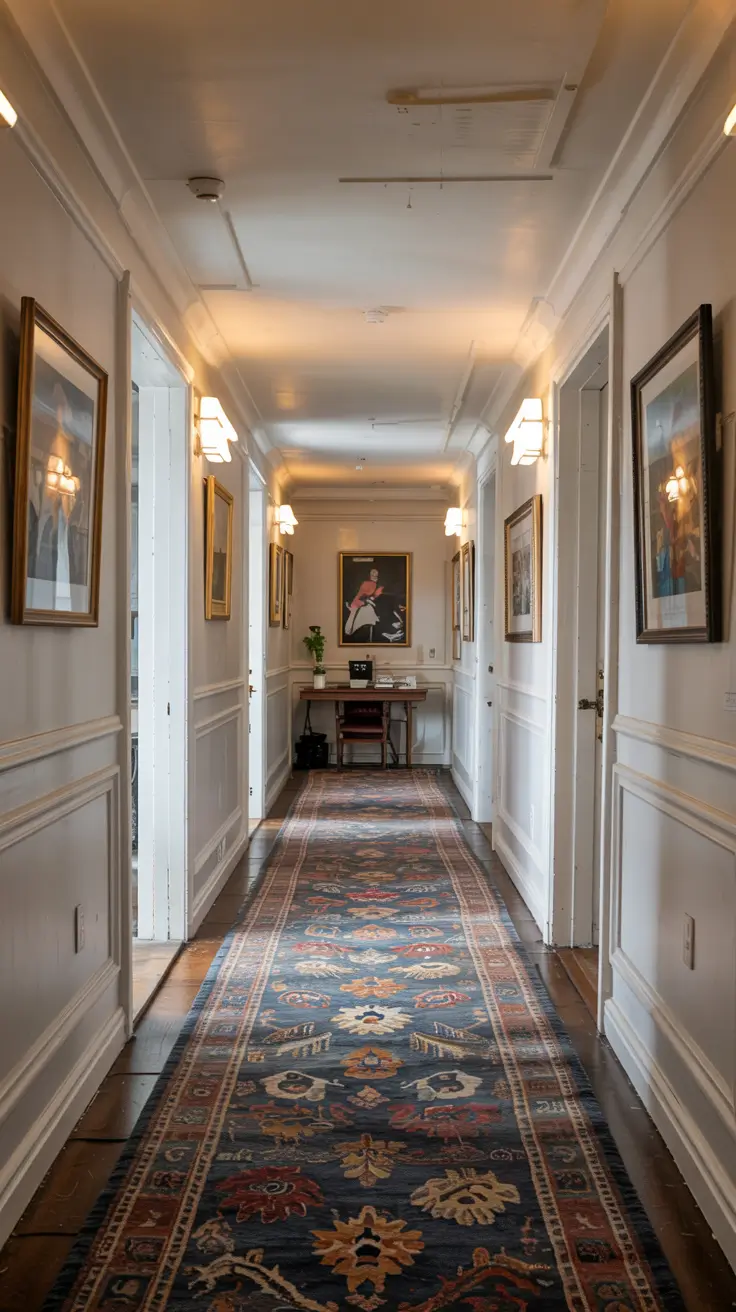
In the physical elements, I tend to put vertical interest to overcome the sheer horizontal line of a long corridor. This could be picture frame moldings, paneling, which is board-and-batten, tall, slim mirrors spaced here and there to allow some light to bounce and the eye to ascend. A continuous or successive series of overlapping runners may visually tie the space together on the floor and cushion footsteps. I use sconces that are low profile and do not stick into the walkway and make any furniture as shallow as possible, such as a built-in ledge or a small shelf to put keys or a vase. Hinges and any visible vents along the corridor should also be coordinated so that the corridor does not appear patchwork.
Lights are the areas where long hallways can make or break in my experience. I would rather combine ceiling lights and sconces on the walls to make it look like it is a layered space, and not flat, and never light up the floor only or the ceiling only. The design magazines such as Houzz and the suggestions given by designers such as Kelly Wearstler tend to emphasize their ability to produce rhythm by repetitive lighting fixtures and I have experienced this design to work perfectly well in long corridors. With the fixtures well-spaced, dim and warm white, the hallway is more like a friendly gallery rather than a service walk.
When I seem to miss one thing in a long corridor plan, it is often an unmistakable center of interest at the end of the passage. I prefer to have something to look at at the far wall of that one – a big picture, some piece of art, a sculptural chair, a small console or perhaps a painted accent panel – something to have people have a place to walk to. I could possibly do a little bit of color blocking or slightly darker color on the bottom half of the wall to give it dimension without making the space small. Lastly, I make sure door trim and any other visible closet or bathroom doorways on the long corridor are well detailed to have the overall line peaceful and harmonious.
3. Smart Storage Solutions With Hallway Closet Remodel Ideas
By working on hallway closet remodel ideas, I consider each closet as a mini room that has to prove its place in the floor plan. Hallways can also contain a rather unexpected array of potential storage, such as the shallow linen closet, the reach-in coat cupboard, and contemporary life places a lot of pressure on space. I tend to begin by explaining what the main purpose of each closet is: coats and shoes can be found closer to the entrance, linens closer to the bedrooms, cleaning supplies can be found in the middle. When that is made clear, I would be able to design interiors that allow everything to be accessible and eliminate the common issue of deep, dark shelves where items become lost.
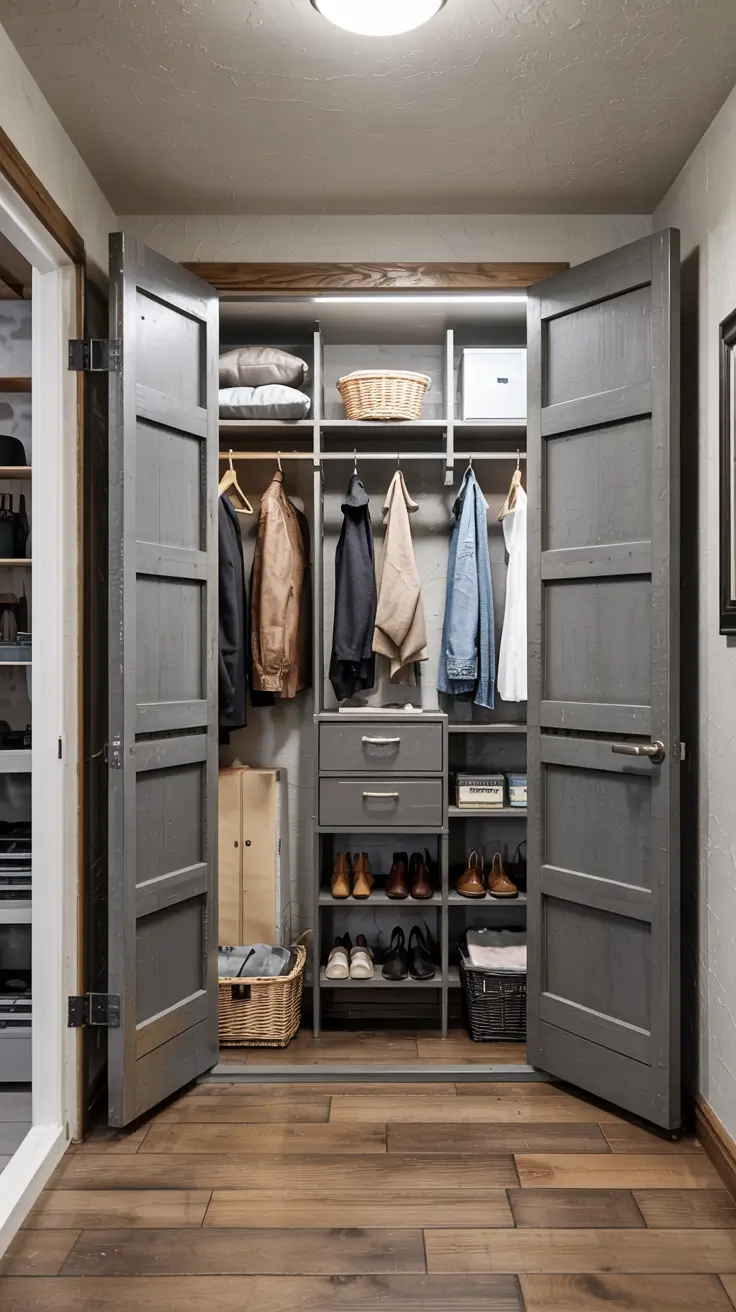
However, within the closet, I prefer combining hanging space with shelves and closed spaces in order to keep the corridor always neat even when the door is open. In the case of a coat closet I would define: two hanging rods to be used, a shelf of strong hook and cubby-holes in shoes or baskets. I would design modular shelves in a linen or utility closet, ventilated bins with smaller items and possibly a pull-out tray with larger ones such as duvets. In case sliding or bifold doors will make the closet more convenient in a small hallway, I will also take those into consideration, yet I also prefer the flat panel hinged doors with recessed pulls as they look clean and modern. There should also be good interior lighting in the closet, including LED strips or motion-activated pucks.
The best ideas of remodelling hallways closets in my opinion are the ones that minimise the visual clutter in the rest of the hallways. Having a spot where one can store seasonal items, cleaning tools and superfluous linens, the hallway itself can remain minimal and unruffled. The United States has design media, such as Better Homes and Gardens and Apartment Therapy, that frequently emphasize the significance of hidden storage in spaces where people are active, and I am inclined to believe that this is among the most lucrative investments in a regular home. A well-organized closet is a little luxury that every time it is opened, and it fills the rest of the hallway perception, as well.
When I feel that a hallway closet plan lacks something, then it is most likely that it lacks elasticity of meeting needs. I would also include a greater number of adjustable shelves, modular shelving that can be moved around, and marked containers or bins to ensure various members of the household are aware of the location of items. I could also replace wire shelving material with solid or melamine shelving material to give it a more professional appearance and be easier to clean. Lastly, I would make sure the style and hardware of the door match the rest of the hallway design to make the closet appear like it was part of the architecture and not a follow-up.
4. Elegant Touches For Upstairs Hallway Remodel Ideas
In thinking of the remodel ideas of the upstairs hallway, I never fail to consider the fact that such corridors are located at the center of the intimate areas of a house. Bedrooms, bathrooms and occasionally a small study or lounge, they are connected hence they should feel safe and calm. I tend to lean towards lighter color schemes in the upstairs than the down, towards warm whites, dull pastels or gentle earths that are cozy at night and invigorating in the morning. The circulation of the upstairs is so much associated with sleeping area that I also consider acoustic comfort and sightlines, ensuring that the doors are in line and close properly, that the light in the hallway does not spill, and that the bedrooms do not receive direct light.
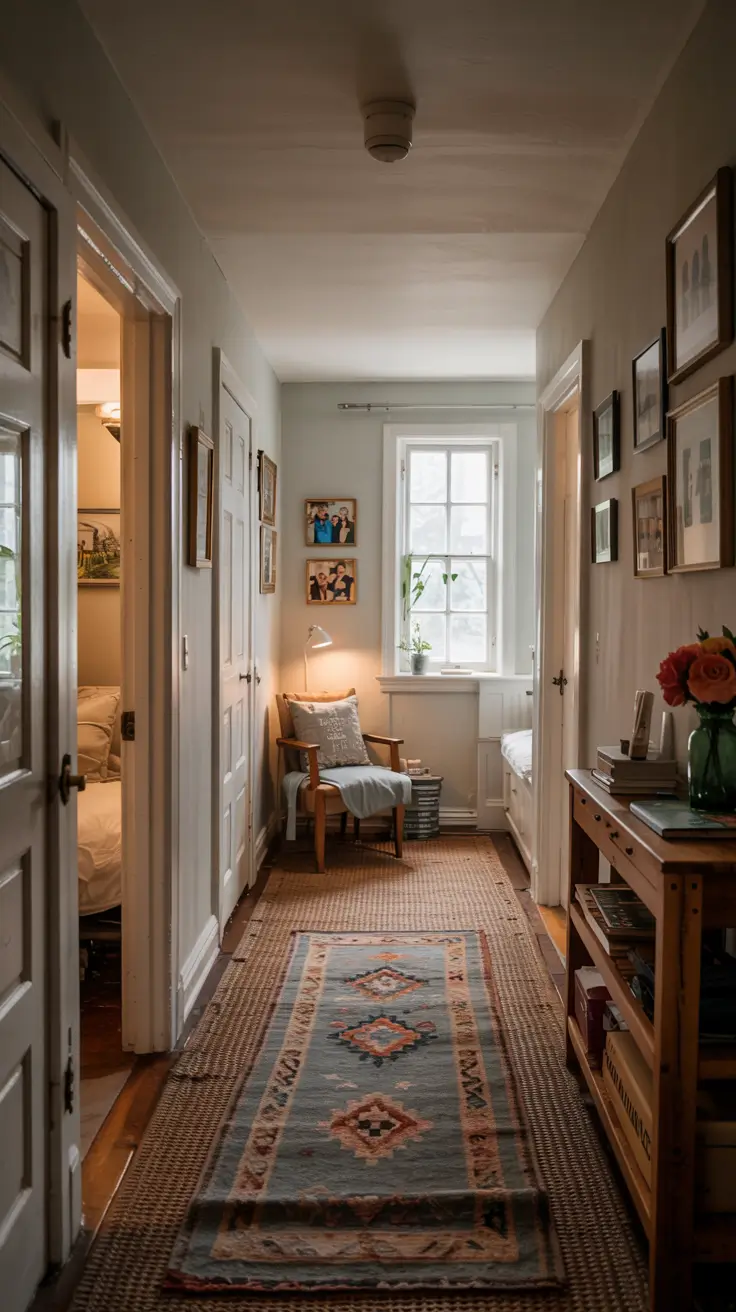
There are typically numerous bedroom doorways, a stair opening and a linen or built-in cabinet found in the physical elements of an upstairs hallway. I prefer to match the door with the rest of the panels and hardware, and, where space allows, I may add shallow built-in storage, or a small reading nook with a chair and a wall lamp. Upstairs artwork is more intimate, such as family photographs, framed children’s drawings or travel souvenirs, though I always place them in thoughtful clusters to make them seem purposeful. To be safe and comfortable, I would give preference to a continuous handrail at the stair, the right spacing of balusters and night lights, i.e. low-level LEDs or night dimmable sconces that are not disruptive to the sleep.
The ideas of the remodel of the upstairs hallway in my professional perspective are the ability to enhance the daily habits that begin and finish every day. I have already found tips on American design based magazines such as HGTV where they suggested to add dimmers and layered lighting in the upper corridors and I do agree with their suggestion. As long as individuals have the chance to make the light emitted at night gentler, the upstairs will feel like a privacy in the face of other potential sleep-deprived individuals. I also prefer more textured materials on the up-stairs as well, such as a wool Runner or grass-cloth wall paper on one wall, to achieve the same effect of cocooning without saturating the space.
When an upstairs hallway plan seems unfinished, it tends to suggest that some elements of ease and comfort be added. This could be a small upholstered bench by a window, a small pile of books in a floating shelf or a runner that stretches along one end of the corridor and to the other end too. I would also ensure that any smoke detectors, thermostats and switches up the staircase are adjusted and not visually cluttered, a point that is left out on most occasions. The effort to bring sanity to those minor small technical details will go a long way in ensuring that the upstairs feels peaceful, harmonious and purposeful.
5. Creating Flow With Hallway Bathroom Remodel Ideas
When developing the ideas of remodelling bathrooms at the hallways, I pay attention to the way the bathroom interacts with the corridor rather than the bathroom itself. A bathroom opening out into a hallway is very visible and guests tend to use it frequently, thus the door, trim and threshold should be treated very carefully. I attempt to ensure that the door style is similar to that of the rest of the interior doors and that the flooring change-over is seamless and unobtrusive. I also consider ventilation and sound, asking to install a good quality fan and make sure that solid-core doors are possible where necessary to prevent spillage of noise and humidity to the hallway.
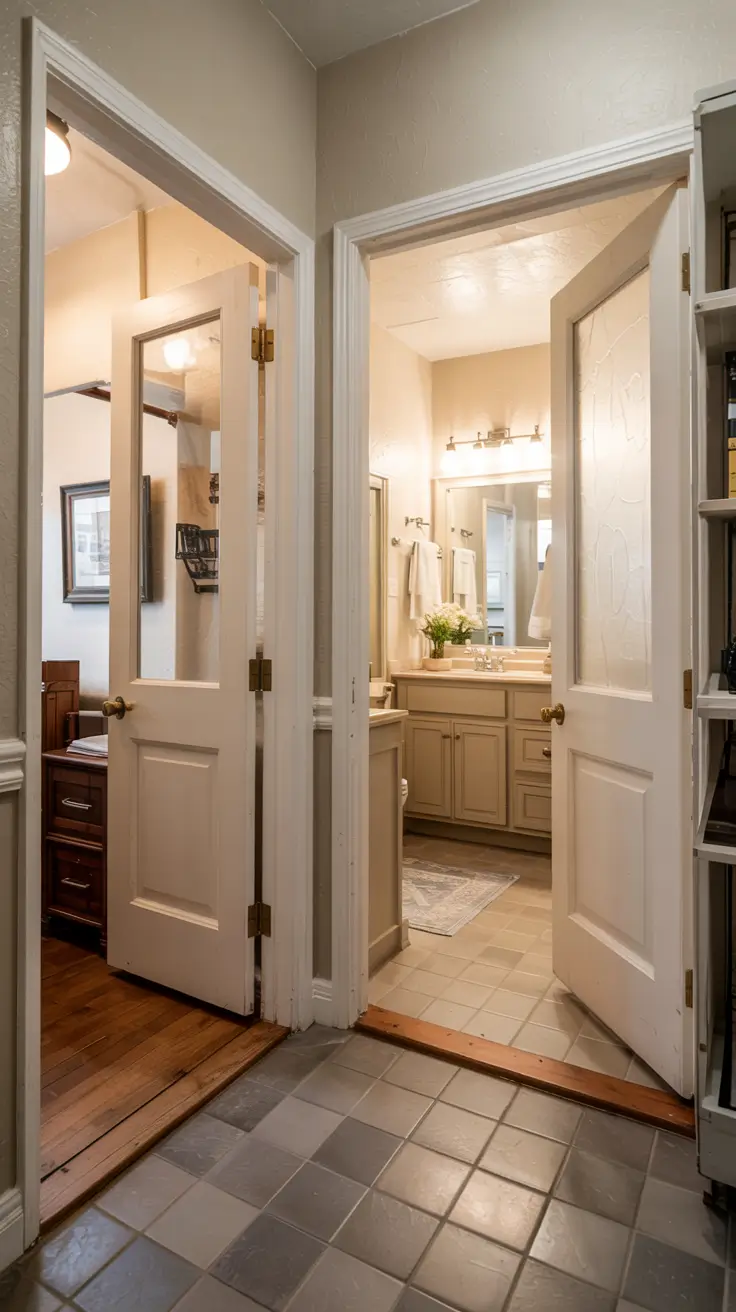
Within the bathroom, I repeat at least one interior material with the hallway, i.e. the same baseboard profile, door color or metal finish. This assists in developing a flow as opposed to a drastic shift in style. I also consider the integration of the tile into the flooring of the hallway and whether a low-profile transition strip can be installed to achieve a neat appearance. Practical features such as towel bars, hooks, and vanity storage are particularly significant in a common hall bath, so I prefer sturdy fixtures and ensure that there is enough storage space available to store the items used daily and not be seen. Since the bathroom can have its own color scheme, the general tone is the same as the corridor to make the flow between the hall and the bath as well-balanced.
In my opinion, one of the easiest, but most useful ideas of hallway bathroom remodel is matching the lighting temperatures of the two areas. When the hallway is warmly lit with white bulbs, and the bathroom is coolly lit with blue bulbs, the juxtaposition may be shocking. According to numerous American professionals in the field of design, the colors temperature to be chosen in the residential area should not exceed 2700K to 3000K and, in my opinion, the selection of the similar range in the corridor and bathroom adjacent to it produces a coherent and flattering atmosphere. Another thing I prefer doing is placing mirrors in the bathroom such that when the door is left ajar, the mirrors reflect instead of reflecting into the corridor.
When I believe that a hall-and-bath relationship is not sufficiently covered, I frequently propose to renovate the hardware of the bathroom door, adding soft-close hinges and making sure that the door closes in such a manner as to be not a blocker to circulation. A pocket or barn-style door may be suitable in other instances, although I select those very selectively so as not to bring visual noise to the hallway. I could also introduce a subtle accent feature outside the bathroom, like a small artwork or sconce, to indicate the entrance in a high-brow manner. These details make the hallway and the bathroom look as one, well thought-out design rather than two unrelated areas.
6. Cozy And Bright Small Hallway Remodel Ideas
My focus when developing remodel ideas on a small hallway is to make the area look open, bright and welcoming without compromising on functionality. Big hallways are easily claustrophobic or gloomy, and I almost always begin by streamlining color and materials. Wall lighting, reflective surfaces and less visual clutter enable the eye to move through the space fast. I also consider door swings and any projecting feature seriously since a small hallway seems crowded even with a few additional centimeters of impediment. What I want to achieve is a walkway that looks nearly easy to walk up despite the real one being very narrow.
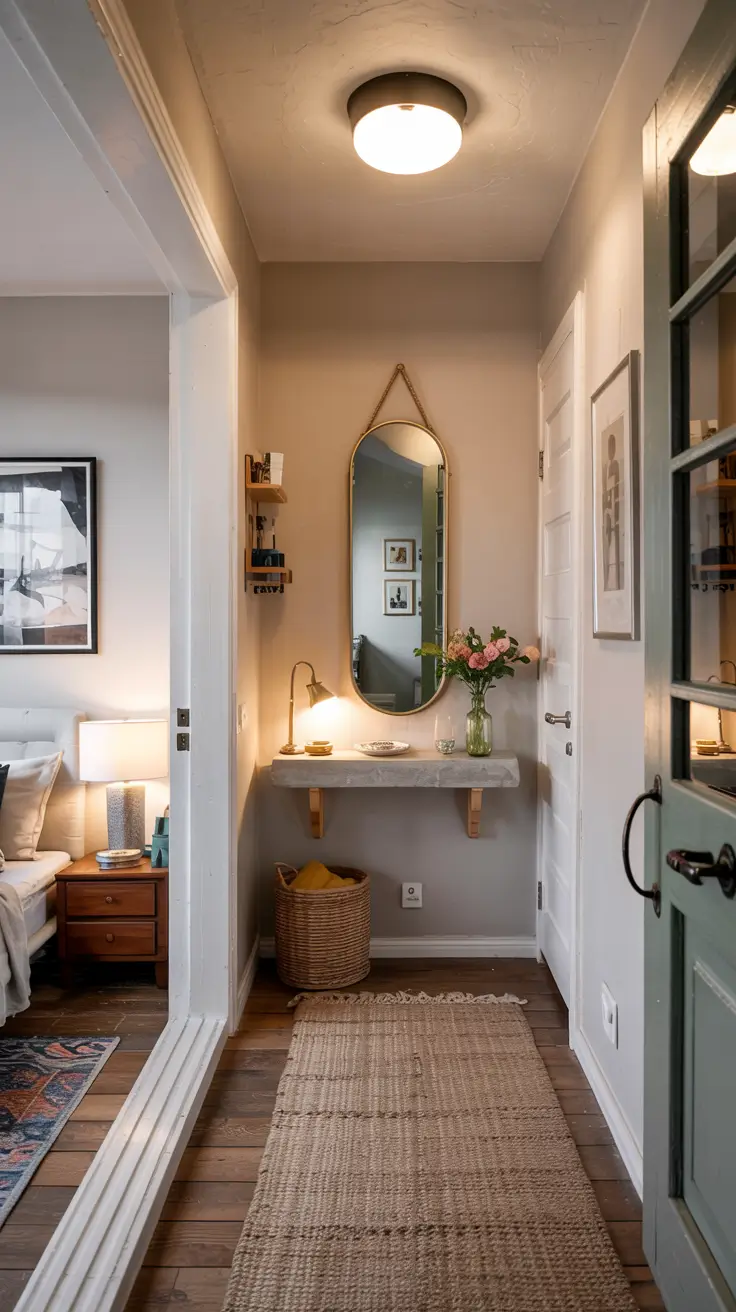
Regarding the components, I would prefer to have flush or low-profile ceiling lights that distribute light evenly instead of forming glaring points. I may have one narrow mirror on the walls, to reflect the light, but I never have heavy frames, or heavy shelves which stick out into the passage. In case it needs storage, I consider built-in recesses, shallow wall cabinets or hooks that can be hidden behind doors. Flooring decisions are quite important in intimate spaces and most of the time I will advise to use the same flooring as the surrounding rooms where possible and this will make the hallway look like an extension other than a slice of a different piece of the plan. A svelte runner in a delicate pattern can help to add comfort without physically reducing the space.
I believe small corridors are in a way doing marvelously well with restraint. Designers such as Emily Henderson have suggested that one should remove accessories in small spaces mercilessly, and I completely agree with this idea. I would rather have one or two large pieces in the small hall, which really count, like a favorite print or a single sculptural wall hook. This maintains the corridor to be quiet especially in the days that it is the first thing people see when entering a home.
When a small hallway scheme is not complete, it is likely to lack some kind of softness or warmth. I could add a runner with a soft feel, a small lamp on a small shelf on the wall or a warmer color on the walls to escape the sterile aspect. The concept of practical information such as coat storage, shoe placement and umbrella placement, is also a concern of mine since they can easily fill up little space when there are no strategically set homes. By meeting those daily necessities in a faint manner, I would be able to maintain the small hallway appearance and feel bright and warm all year long.
7. Long Hallway Design Ideas To Add Depth And Style
When I come up with long hallway design concepts to make them more detailed and stylish, I think like a lighting designer and a curator at a gallery simultaneously. Long staircases, either on the fourth or the first floor, are easily tiresome when the walls are empty and the lighting is two-dimensional. In order to make it three-dimensional, I think it would be advantageous to provide some variations with color changes, slight arches or openings, and some well-thought-out points of interest throughout the length of the corridor. I even maintain the base palette, still unified, however, I may even experiment with a bit darker colours at one end or the bottom section of the wall to provide some perspective.
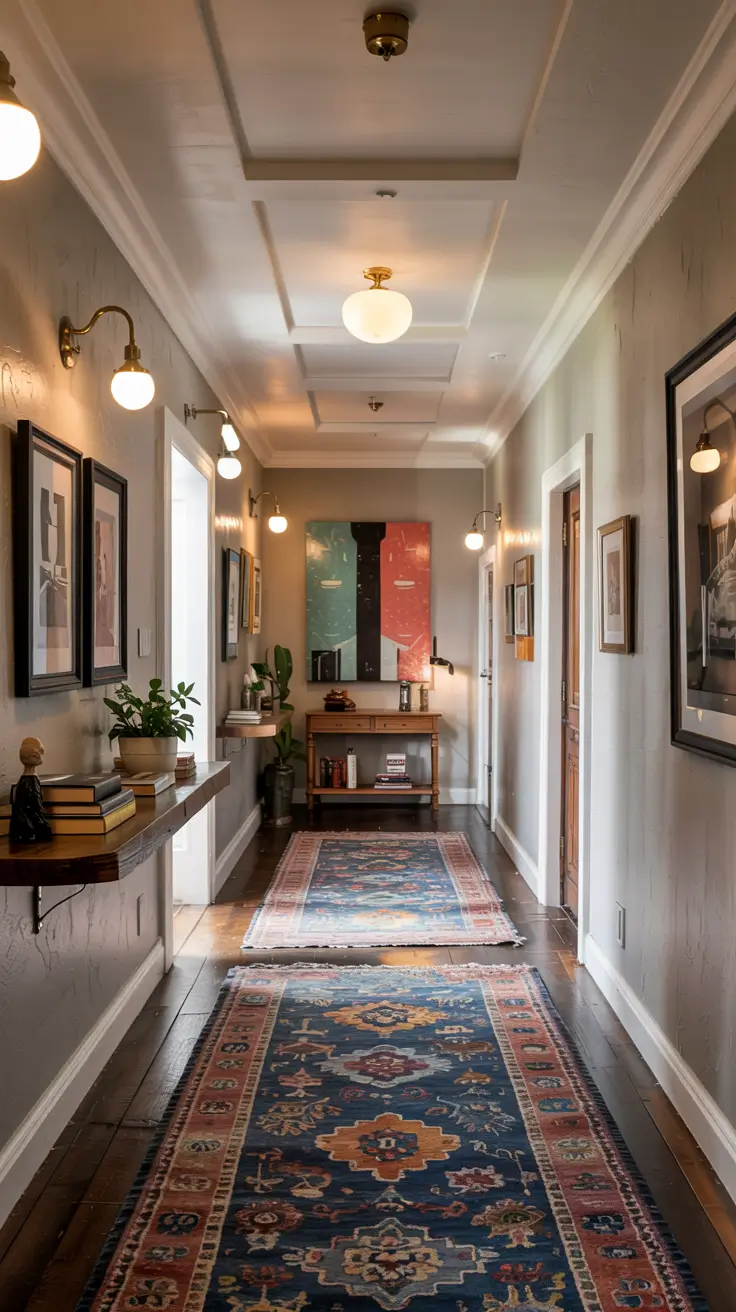
The features I will define in long corridors frequently consist of the repetition of lighting fixtures, the selection of art pieces and sometimes the elaboration of building elements such as a niche or shallow arch. As an illustration, I could create a wall sconce pattern with an equal spacing of the sconces, an art shelf on one side, and a system of coordinated frames that is telling a coherent story. A continuous runner of simple directional pattern on a floor can help guide the eye in a forward direction and connect the materials on the floor. Where the hallway doors are on one side, I occasionally paint the doors and some of the trim in a darker color to make them look more prominent, leaving the other wall pale to add depth.
Personally, in my line of work, I believe that the most important aspect of a long corridor is to think in segments to create a stylish hallway, instead of it being unending. A lot of American interior design features in magazines or online platforms depict cellular divisions in the hallway by alternating art, light or ceiling detail. This technique I really like: maybe a little gallery can be the first zone at the entrance, the middle zone can be a little console and a mirror, and the end zone can be an eye-catching work of art or a window treatment. This tunnel thinking makes the experience of walking through the corridor interesting and multifaceted.
In case even a long corridor construction still looks flat, I would think of more accentuated architectural expressions that should be easy to introduce as well. This may be either an ornament as simple as a ceiling ornament like beams or shallow coffers, a painted stripe at picture rail height, or a variation in wall texture in a portion. The ratio of negative space and ornamentation is another aspect I would check according to which there should be sufficient areas of empty space on the wall to make sure that the most important elements shine through. By playing with these details, I will be able to turn a long passage into one of the most interesting and pleasant sections of a house.
8. Functional And Beautiful Hallway Closet Renovations
The best hallway closet remodel ideas that I consider today are a combination of highly practical and clean lines. I prefer to design the hallway closet as a designed part, rather than an outcropping, to make the corridor look as though it has a visual anchor. On 2026 inspired designs, I tend to apply floor to ceiling millwork in a light neutral color palette such that the closet would resemble a relaxing wall panel rather than an oversized box. I also listen to the openings of the doors leading to the corridor as replacing sleek sliding or flat front doors can ensure that the traffic route is unclogged. The outcome is a more spacious and less congested hall that is more oriented to everyday practices.
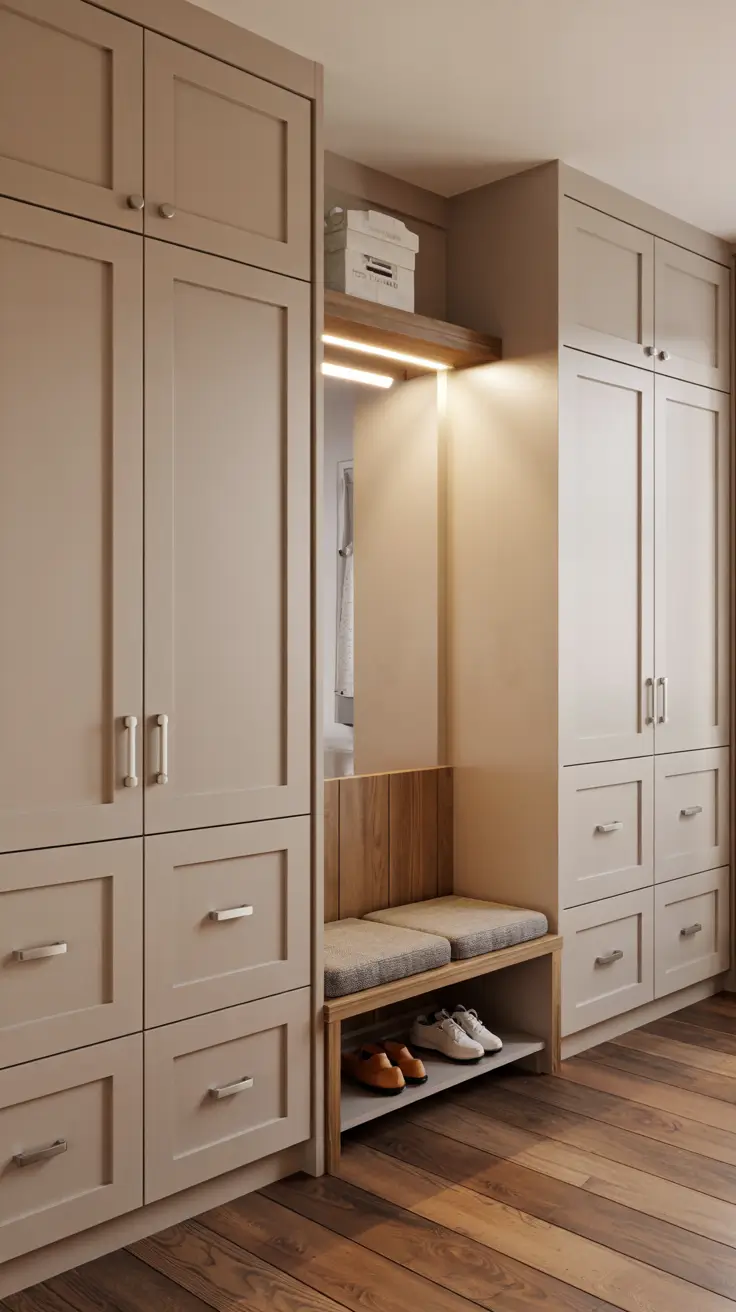
I will arrange particular areas within the closet of coats, shoes, bags, and other seasonal items to ensure that each category will really have a home. I prefer to place two hanging rods in front of the door to store all my outerwear that I use daily and deep drawers under the stairs to store shoes and make the shelves high up so that I can store out of season clothes. Key, dog leash and hat pull out trays make sure that the front side of the hallway is neat without any mess on its surfaces. I tend to install in built hooks on the door interiors to hang bags or scarf, as it occupies what otherwise would be wasted space in a vertical format. Everything is made to stay contemporary and sophisticated with soft close hardware and subtle recessed pulls.
Personally, the most effective ideologies of remodelling a hallway closet strike a balance between openness and concealment. I have read projects in American design magazines where designers take closed cabinets and place a small open niche to display or a bench, and the hallway would instantly feel purposeful. I borrow that and place a warm wood bench with a cushion and low shelf with daily shoes next to the closet. The incorporation of hidden storage and the limited-sized styled moment makes the hallway feel more welcoming without making it less practical. I also realize that having a mirror panel on the wall or the door of the closet or a wall next to it increases the light and the corridor appears to be even bigger.
There is still some detail that I would like to give on this part concerning the finishes applied in various types of styles, like matching matte white furniture with the light oak enhancing of its appearance to look Scandinavian or having the deep painted doors with brass handles to make it look more traditional inside. I would further elaborate on how to modify this closet design to fit very narrow corridors by using shallow cabinets and additional vertical storage space. Lastly, I would like to address the concepts of remodeling small hallway spaces whereby freestanding wardrobes or cabinets can replace built in closets where there is limited space.
9. Contemporary Designs For Upstairs Hallway Transformations
In planning Upstairs hallway remodel ideas, I give a special consideration to how this level is connected over the bedrooms, bathrooms, and occasionally a staircase overlooks the same. I normally begin with some simplification of the envelope with which I have the smooth walls, constant color of paint, and trim simplified to make the Upstairs corridor feel roomy instead of cluttered. Since the natural light is usually less abundant here, I tend to go with soft whites or lighter mineral colors on the walls with a a little darker floor to ground space. Footsteps can also be softened by having a continuous runner in a faint pattern and this has an effect of guiding the eye down the corridor. This modern ceiling allows the art, light and doors to be superimposed without the hallway being overworked.
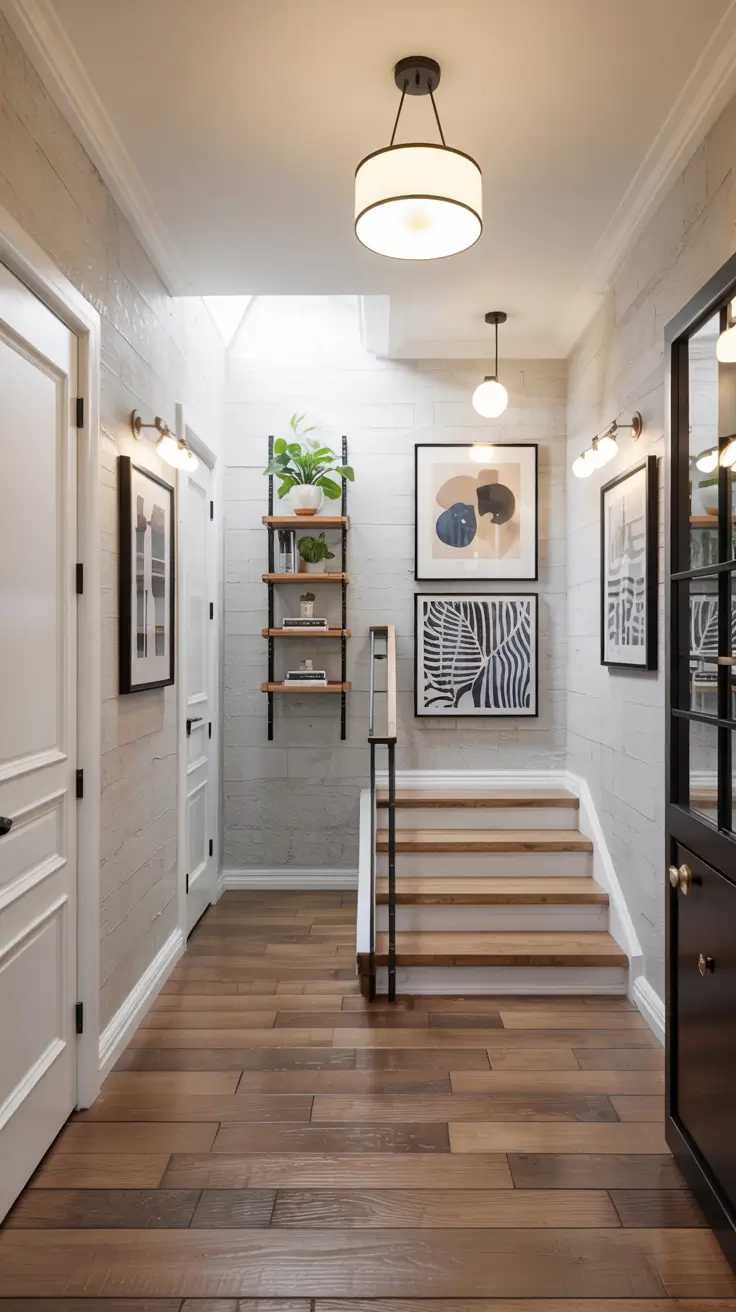
Regarding building materials and furniture, the aspect on which I tend to focus is the railing and the doors in an upstairs hall. When heavy balusters are replaced with clean vertical metal spindles or narrow wood-posts, the appearance is immediately updated without endangering it. I prefer to select plain flat panel doors with little or no casing and using all the same hardware on them, which soothes the eye when many bedroom doors run along the same hall. Providing that code clearances are followed, a small landing zone can be composed of a small shelf mounted on the wall or near the top of the stairs, which may accommodate books, candles or a plant. In case of a big blank wall, I will design a unifying gallery of framed paintings or photographs on eye level to bring personality without overcluttering the wall.
According to my experience, the best modern changes to the upstairs hallway are grounded in the cleverly selected lighting. I tend to rely on the suggestions that can be found in the top design magazines in the United States suggesting a combination of ambient and accent lighting in the areas of transition. To illustrate, I am considering a row of low profile ceiling lamps to provide general lighting and a statement pendant lamp towards the staircase and picture light over larger art work. This stratification makes the space secure and light and it still seems to be designed. I also discover that new trim and new door finishes can sometimes have more effect than one thinks when they are used to replace yellowed ones.
To elaborate on this part, I would include additional illustrations on how to manage tight corridors of Upstairs halls where width is minimal e.g using wall mounted sconce, rather than over sticking fixtures, and using low profile door hardware. I would also like to describe a basic color palette plan of various styles, warm contemporary and cool minimalist, so that the readers could find the approach to fit their own homes. Finally, I would add suggestions on how to incorporate sound absorbing elements such as rugs and fabric covered panels in the improvement of acoustics in a busy upstairs corridor.
10. Connecting Spaces With Hallway Bathroom Layout Updates
When considering the ideas of remodelling bathrooms I always consider the way the bath door, circulation and sightlines merge with the corridor. The break-up of a flow may be done by a hallway bathroom, or it may aid in the connection of spaces, depending on the way the layout and finishes are implemented in the bathroom. I prefer to evaluate a conventional swinging door consuming space in the hallway, and whether a pocket or sliding door could liberate this space. I also watch what you look at whenever the bathroom door is open and hopefully, the view is set to a clean wall of vanity or a simple tiled object and not the toilet. Cohesiveness of the whole zone is achieved by considering the hallway and the bathroom as one unbroken design issue.
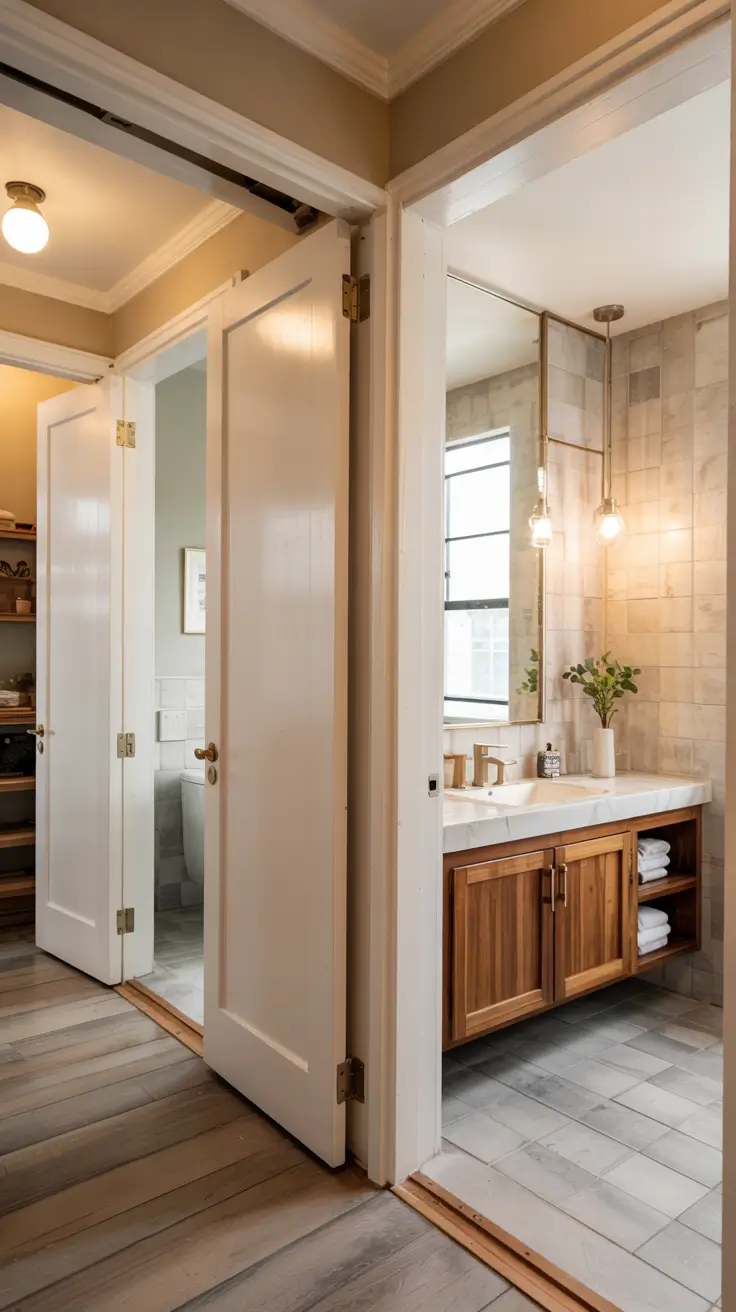
I design fixtures and furniture in the bathroom which do not violate the footprint of the hallway. The vanity is also mounted on a wall that is very shallow in depth to create an illusion of a larger room and a spacious entryway and passage. I prefer to have the floor running a large format tile in the same direction as the hallway boards to actually tie the two together. Narrow ice cream shelves by the door can be used to store additional towels or daily products without cramming on the entry. I prefer a muted color scheme, when possible, which associates with the walls in the hallway, with the same shade of white or neutral with a slightly darker shade on cabinetry to enhance the association.
I believe that lighting and consistency of hardware is one of the most successful methods of enhancing the relationship between a hallway and a bathroom. I also tend to repeat that metal finish to the door handles of the hallways onto the faucets and towel bars of the bathrooms and this makes them feel as a continuation of the tale. According to design professionals, matching the height of trim and baseboards when two rooms are joined, and in my experience, this simple rule results in even minor renovations seeming more like an architectural work. I also enjoy putting in a dim night-light in the bath room that leaks into the hallway and enhances safety at night without glare.
To reinforce this point further, I would include more information about privacy and ventilation, as hallway bathrooms are frequently located next to bedrooms and living rooms. I would like to discuss the possibility to have frosted glass panels or high windows to provide light without losing privacy and how to specify a quiet and efficient exhaust fan. I would also not stop at layout sketches of how simple relocations of objects such as the vanity or the toilet can result in a more favorable view of the hall. Lastly, I will discuss how these ideas of remodeling bathrooms that are situated in the hallway would work in older houses when the pipes and walls are more difficult to replace.
11. Space-Saving Tips For Compact Hallway Remodels
When I embark on minute hallways remodel concepts, my initial thought is to remove the circulation zone and intelligently utilize wall space. In small corridors, just inches of extra width can alter the experience in the room, and I will frequently begin by taking overstated trim, radiators, or deep pieces of furniture, which narrow the space. I use light color on the walls and floors that extend throughout the house that make the hallway not feel isolated. Light can be reflected through mirrored surfaces either by a full length mirror or by mirror-closet doors, which have an effect of enlarging the space. Such minor manipulations make a less cluttered starting point of more specific storage and decor.
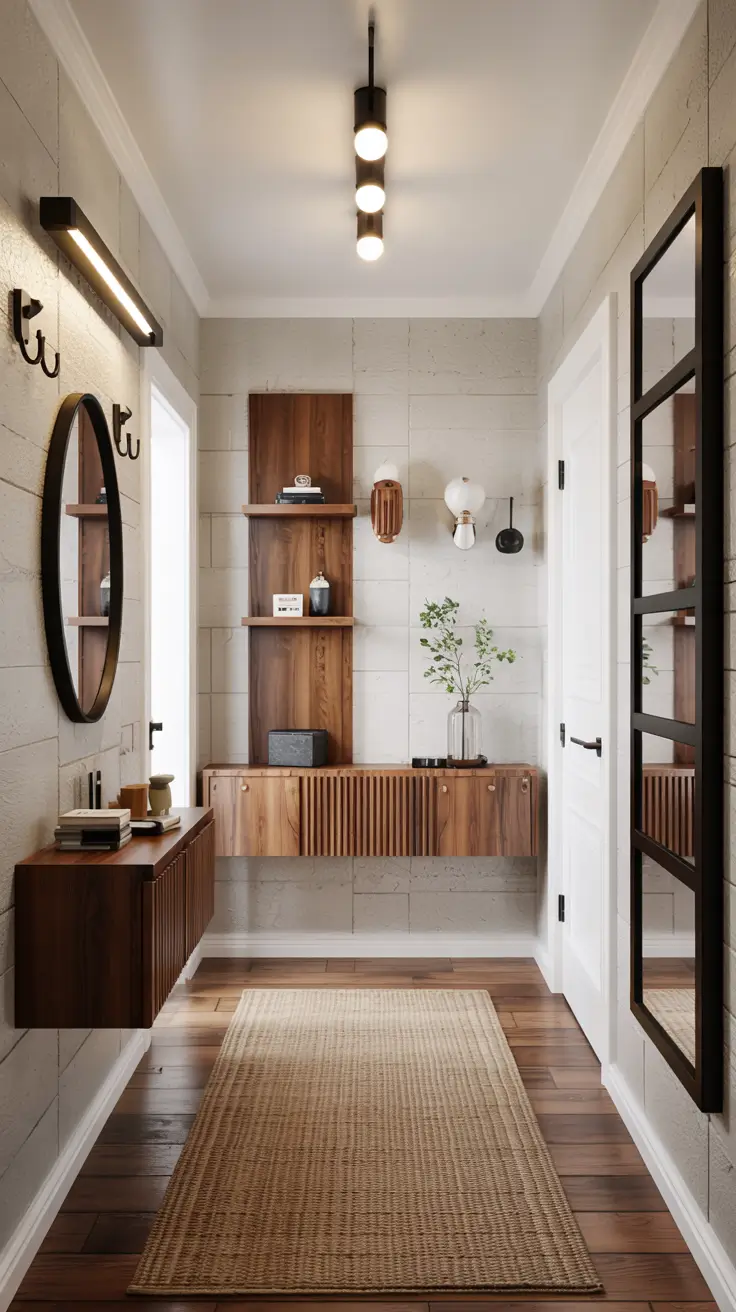
In case of furniture and built in objects, I would have to depend on shallow ones in small hallways. Specifically, I prefer to outline wall mounted shelves, narrow consoles, and recesses as opposed to deep cabinets which stick out into the walk-in area. Coat hook, narrow shoe tray, floating benches and more can be adjusted to a reasonable size to ensure clearance, yet provide functionality. I would recommend that in other instances, I would make one side of the wall a recess storage niche with trimming, making a small drop zone without occupying floor space. Even the rugs are important in this case, and I would use low-lying flat woven runners, which will not form bumps underfoot.
In my experience, narrow corridors have been made much better with a clear hierarchy of what should be displayed on the shelf. Designers usually recommend editing within a narrow area, and I agree with this idea completely. I choose one or two focal elements (a single piece of art at the end of the hall or a sculptural pendant light), and leave other surfaces relatively uncluttered. The use of restricted accessories makes the eye not too cluttered and the hallway look bigger than it is. The style is particularly effective when it comes to hallway remodel ideas 2026, as a lot of individuals are going toward cleaner, less cluttered designs.
As a way of completing this part, I would like to include more specific measurements of recommended furniture depths and clearances to enable readers implement small hallway remodel ideas with more confidence. I would also like to give an example of modular storage systems which can be tailored to fit narrow corridors without necessarily using full custom millwork. I would also build upon color and texture solutions, including tone on tone color palettes and low contrast patterns, to make compact hallways open and spacious.
12. Long Hallway Lighting Ideas For a Dramatic Effect
Lighting is often the first tool I use when I address long hallway remodel ideas because it generally breaks up the length and provides rhythm to them. A Long corridor may easily resemble a tunnel when only one light is there at the end of the corridor therefore I would consider having a row of lights placed at even spacing on the ceiling creating a soft procession. I tend to match this with picture lights or wall sconces to illuminate art or architectural details in between. The overlapping of such sources creates depth and interest to the hallway rather than a mere passage. I also consider color temperature where warm white light is provided which is inviting instead of intimidating.
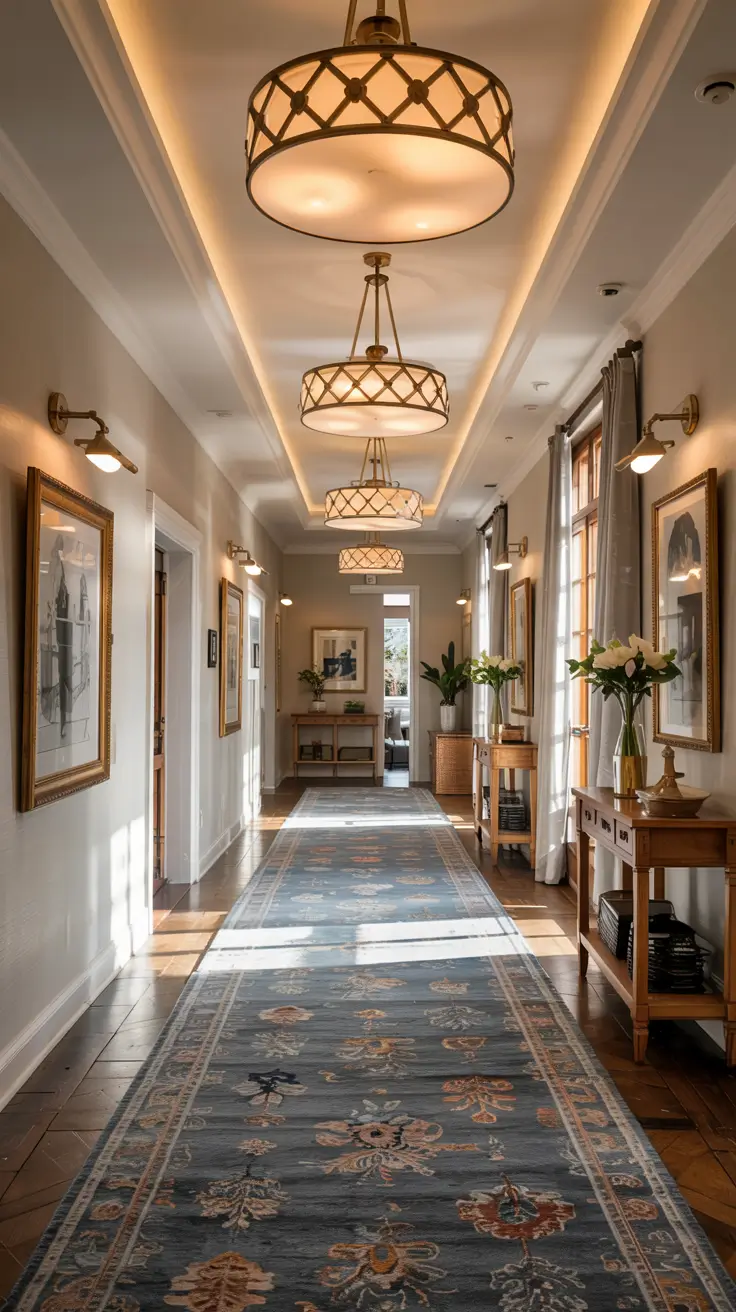
Regarding the fixtures and layout, I prefer to combine practical and decorative features along a long corridor. A series of flush mount or semi flush ceiling lights give the required brightness, and they also evenly spread the light down the line. Among them, I would situate two or three statement pendants or lanterns, which provide a sculptural element especially as high as the ceiling can be. Slim sconces on the walls with shades or plain metal shapes are able to illuminate the walls up and down, creating drama and therefor making the architecture emphatic. I also discover that having a continuous runner rug under such a lighting set-up makes the long space to be visually organized.
I have discovered that most of the lighting designers suggest forming areas in a long corridor with switches and dimmers, which I support. I prefer installing ceiling-lamps on one circuit and decorative sconces on the other, so that I can change the atmosphere according to the time of the day. In the evening, it is possible to dim the main lights and use the sconces as a soft glow to turn the corridor into something warm instead of cool. To clean or have daylight, it is best to take everything to maximum brightness to make the hallway useful. This is particularly convenient in residential buildings where the walkway is visible to other living areas and has to adjust to various activities.
I would add a little more information on this section to explain how to match the lighting with the work of art and color decisions along a very long corridor. I also would like to demonstrate that it is possible to use spotlights to illuminate important objects and keep the total brightness of the light on an equal level. I would also incorporate such instructions as the distance between fixtures and their height to ensure that people who might read my writing will not have to struggle with the glare and dark spots. Lastly, I will mention smart lighting controls that will enable the long hallway lighting ideas to be programmed into scenes so they can easily switch the mood with a push of a button.
13. Minimalist Style Inspirations For Small Hallways
In creating minimalist small corridors, I am concerned with restraint and clarity to achieve the effect of a calm and deliberate space. I usually begin with a small color scheme, with walls that are usually white or very light with wooden floors made of natural woods or light stones. This forms an atmosphere of silence that makes the corridor look bigger and brighter. I then scrutinize closely at what truly needs to be present and eliminate anything that looks like visual clutter. The intention is to have the architecture and light speak out first, and only some powerful pieces to establish the style.
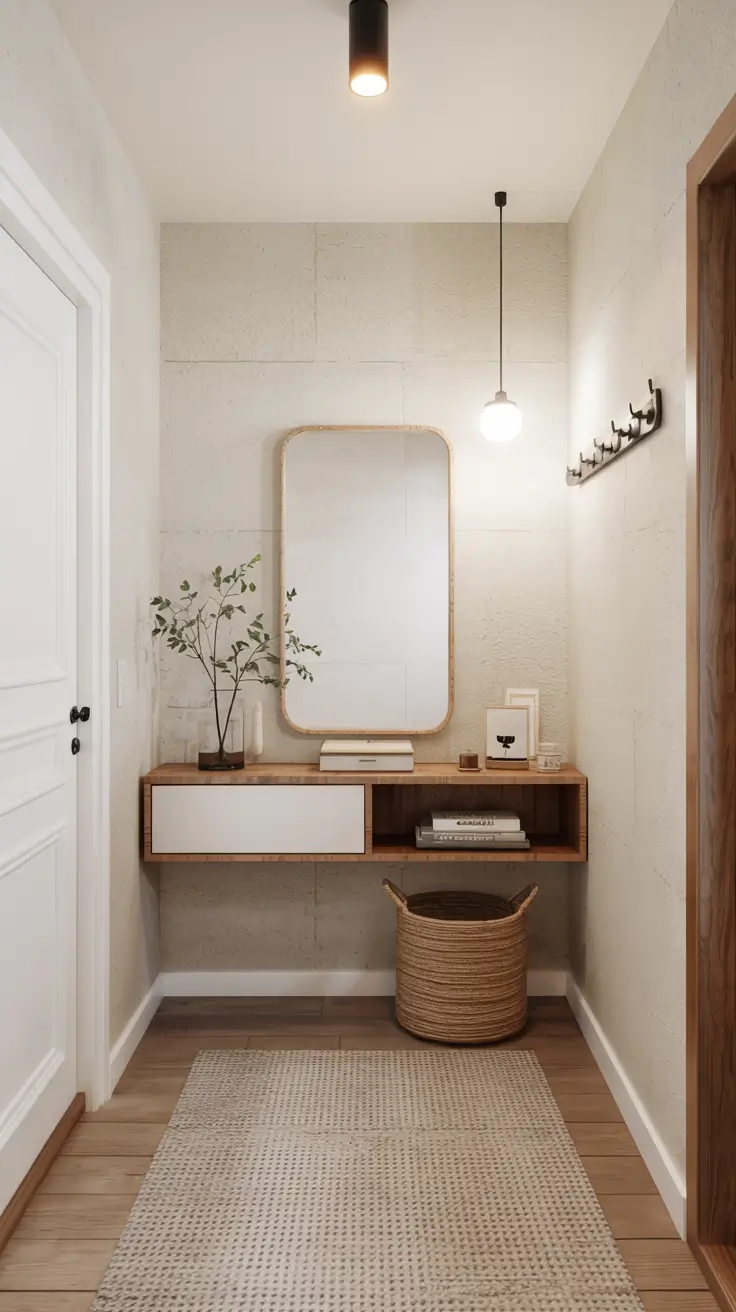
To decorate a minimalist bedroom entrance with furniture and other objects, I choose objects with smooth lines and simple shapes. A single-drawer floating console shelf can be used to create a storage solution but will not be bulky. Instead of a set of mismatched hooks, I could include a single, subdued wall hook rail that is made of wood or metal to hold necessary outerwear. A light frame, encasing a single large mirror, can be used to reflect light, as well as sculpturally itself. Neutral-colored, solid or slightly patterned, floor runner is placed on the floor to make the look smooth and understated.
Personally, I think that minimalist hallways are effective when each object is intentional, which is also the values described by people involved into the publication industry in America. I tend to use that concept by having no more than one or two significant pieces of decoration, particularly a ceramic vase or an abstract print in a frame. I also consider negative space, where I leave a part of the wall and floor uncovered in order to give the eye a rest. That makes even the smallest ideas of remodelling the halls turn into something high-end, since nothing seems to be randomly placed or cluttered.
To fill in this section, I would include more specific examples of minimalist styles, like Japanese inspired, Scandinavian or soft modern and demonstrate how each may inform the selection of finishes and details. I also would like to give recommendations on keeping minimalism in real life such as built in storage within hidden area to put all the things that we keep in our everyday life, as well as cable management ideas on nearby sockets. Lastly, I would also comment on how the minimalist ideas can be applied to families or shared houses where more convenient storage is required, but without hampering the clean look.
14. Creative Storage Hacks For Hallway Closet Makeovers
I approach the closet as a flexible toolkit, as opposed to a box, when I arrange creative hallway closet remodel ideas. I begin by laying out all that should be stationed around the hallway, coats, shoes, sporting equipment, cleaning stuff, etc. Next, I sort these items by how often they are used and size, which makes me make decisions on which items to be the most accessible and where to be stored higher or deeper. The attitude transforms the closet into a routine system, which accommodates everyday routines rather than a dumping ground. It also releases the visible hallway surfaces making the corridor itself tidy.
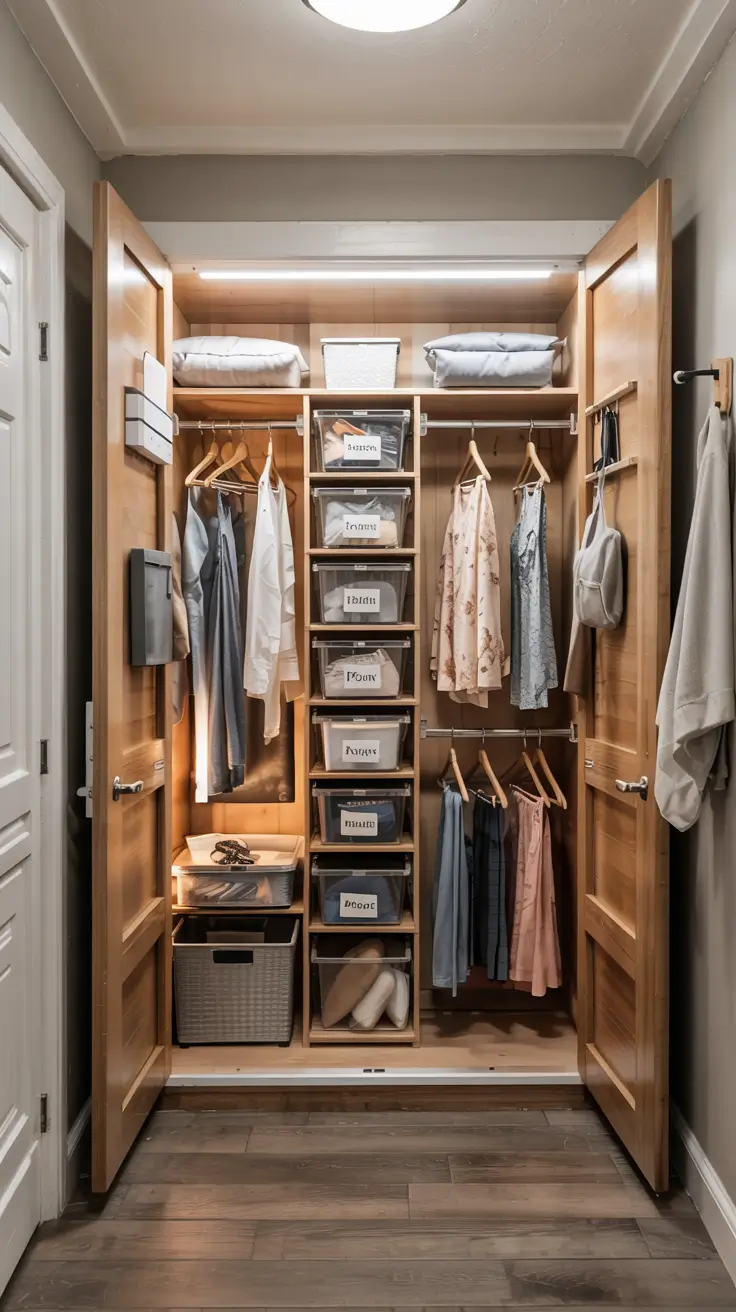
I prefer to stack various forms of storage in the closet to use all the inches. I frequently use double hanging rod of short objects with little tall parts of dresses or coats, and I use pull out baskets of hats, scarfs and gloves. The door organizers can store small items such as umbrellas and pet accessories but larger items are placed in stackable bins on the floor. I also prefer clear or labeled containers as I can know what is inside without digging by just looking at these containers. A bag dividing verticals, mail tray, a thin mop and broom holder attached to the side wall are all aiding the closet to act as a mini command center.
With time, I have realized that the lighting and hardware improvement within the closet may go a long way in ensuring that the closet becomes very pleasant to use. I usually use motion activated LED strips or puck lights which means that I am never stumbling in the dark. Very plain, heavy hooks and rods with a uniform finish hold the appearance together and they replicate those of the hardware found in the rest of the hallway. Most people working in the design media on the importance of regular editing and labeling and I have come to realize that adhering to this advice makes the system continue to work even after a long time. When things are in their place then everything is much easier to keep order.
To make this section more comprehensive, I would include more concepts depending on the specific lifestyle, like separate sections of kids items, home office supplies, or hobby gear in the hallway closet. I would also like to add tips on how renters can adapt built in shelves such as modular hanging organizers and freestanding drawers where they have no control. Lastly, I would elaborate on the coordination of the interior of the closet with the style of the entire hallway, in such a way that even when the doors are open the area still appears neat and consistent with the rest of the design.
15. Modern Flooring Ideas To Refresh Any Hallway
Whenever laying flooring in a hallway, I will always begin with durability and continuity since, this place encounters more foot traffic than nearly anywhere. I gravitate towards tough but stylish designs in the context of hallway remodel ideas 2026 such as luxury vinyl plank, engineered wood and large-format porcelain tile flowing into the next room. I prefer to have the same floor in a Long corridor and adjacent rooms to give the impression of a larger area and eliminate the jerky effect. In case of pets or children at home, I would rather have a finish that is not easily scratched or cleaned as hallways are likely to accumulate dirt coming in and out back doors. The quiet flooring of the hallway can be used to form a serene visual backbone allowing more ambitious decisions to be made on the walls or the ceiling.
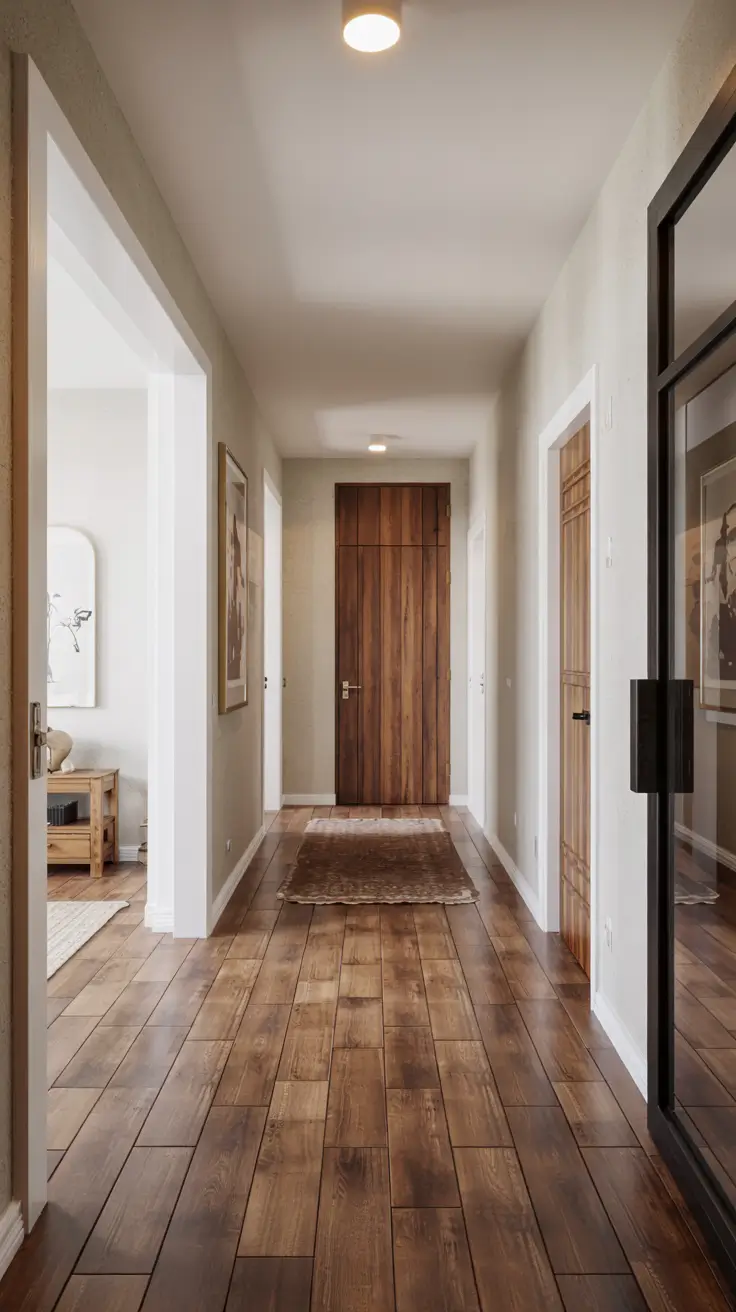
Specifically in regards to the material and details, I tend to state wide plank oak or ash in a mid-tone matte finish since it conceals dust and is warm to the foot. To be more graphic I prefer patterned porcelain tiles in a rather subtle geometry, combined with a plain flush transition with the other rooms so that the hallway does not seem like you are in a hallway. Runner carpets can be very significant in comfort and sound and I tend to pick low-pile, washable runners with a non-slip backing that repeats the accent colors of the other rooms nearby. When the hallway leads into a bathroom or mudroom, I occasionally move to a matching tile design close to the door to accommodate moisture without altering the overall tone and undertone. All flooring items, baseboards through thresholds, must not appear to be an accidental acquisition.
Flooring is where I have found that most people are trying to save, yet on the other hand it is where a bad decision is the most evident and irritating in the long run. I tend to remember the type of advice that we have had presented by the design editors of America, that you should invest in the surfaces that you touch and use every day like floors and door hardware. When I pass down a completed hallway, I can tell at the initial steps of the walk whether the remodel will age gracefully or begin to appear weary-eyed in a few years. I also understand that good floors are effective in resale value because they put the home together and the layout looks more fancy.
The next thing that I would still consider adding to a hallway floor plan is an effective plan on how to transition, particularly on areas where stairs, closets, bathrooms, and various other structures go. I prefer to lay out where exactly the changes in flooring will occur and determine beforehand whether to use flush metal strips, wood reducers or have no transition at all in case the thickness is the same. The early thinking can prevent me clumsy bumping or misplaced pieces of the otherwise beautiful corridor, which render it unfinished.
16. Elegant Paint And Wallpaper Ideas For Long Hallways
Once I address a Long corridor that reminds me of a tunnel, paint and wallpaper become my primary resources in terms of redefining the perception of the space. My idea of the long hallway remodel is not to create the sense of the endless, narrow hall, but rather to divide it into the visual areas rather subtly. On the upper walls I may apply a soft and continuous neutral warm white or pale greige and a deeper colour or wainscoting on lower part to give the space a ground. With the concept of hallway remodel ideas 2026, I am increasingly observing the preference to have a soft contrast instead of the black-and-white schemes, which might be associated with austerity in a tight space. The heightened selection of tones and finishes will allow me to make a corridor that is both brighter and more personal.
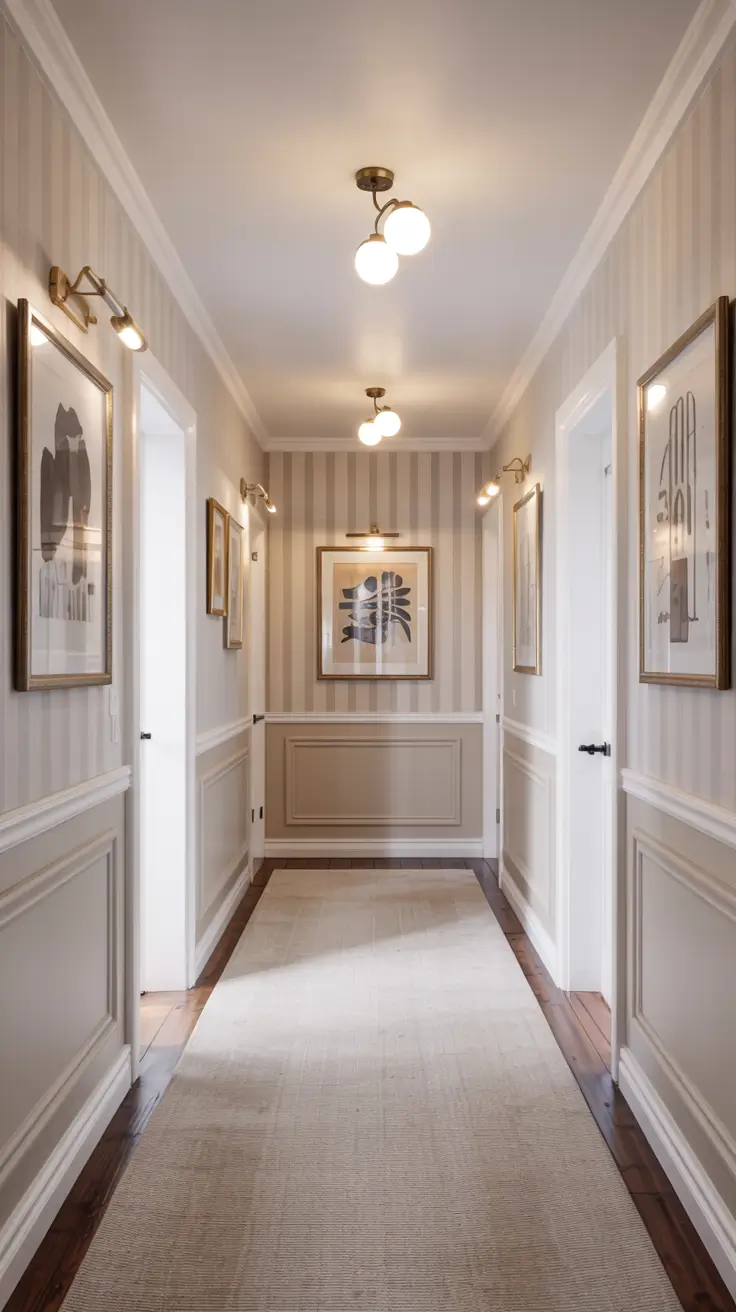
In working with wallpaper in a long hall I frequently use small scale patterns or vertical stripes which literally lift the ceiling without excessive eye strain. An example may be a micro-floral, a fine stripe, or a textured grasscloth, which will not cause the walls to seem to be closing in. I tend to paint doors and trim slightly darker than the wall color to add a subtle depth and I always prefer to paint in a matte or eggshell finish to reduce glare when using artificial lighting. When the hallway is linking several rooms, I will choose colors that resonate with one or two of the accents in each room to make the trip feel like a whole rather than a clash of paint. Picture lights or wall sconces are then placed strategically to illuminate the wallpaper or paint, making the Long corridor a silent gallery.
In my view, the long hallway is one of the most ideal spaces to use the paint styles that may seem unsafe to use in a bigger room. I have witnessed suggestion of color drenching – painting walls, trim and even ceiling in one colour – in the American media, so that narrow spaces can be made to look curated, not crammed. I have applied this technique to a hallway where the amount of natural light is scarce, and instead of using dark colors, I picked blues with a moody effect or olive greens and light clay colors that look cozy instead of dark. In such projects, the well-planned color is used as a design statement in the hallway that makes it memorable rather than functional.
What I frequently wish to include with long corridor remodel concepts is a definite boundary, like an archway, a change in the ceiling treatment, or a change in paint color to indicate that you are moving into one area of the house to another. To make the space look less infinite, I could also add a bit of light at the end of the hall to attract the gaze. When I use color as a wayfinding tool instead of mere ornamentation, I will be able to transform even the longest of corridors into something considered and purposeful.
17. Stylish Decor Ideas For Upstairs Hallway Walls
When I remodel hallway ideas on the upstairs, I do remember that this is the space that usually has doors to bedrooms and serves as a silent backdrop to more intimate areas. An Upstairs landing should get as much treatment as the main floor, only the decor and feel of this room should be less formal and more homey. I prefer to begin with measuring wall space and natural lighting in order to determine what will have the biggest effect: gallery wall, large-scale art or architectural elements. Since the halls that go upstairs tend to be a bit narrower, I will concentrate on decor that will mostly be flat towards the wall and will not cause a risk in narrow corridors. This simultaneously makes the Upstairs area feel curated and safe.
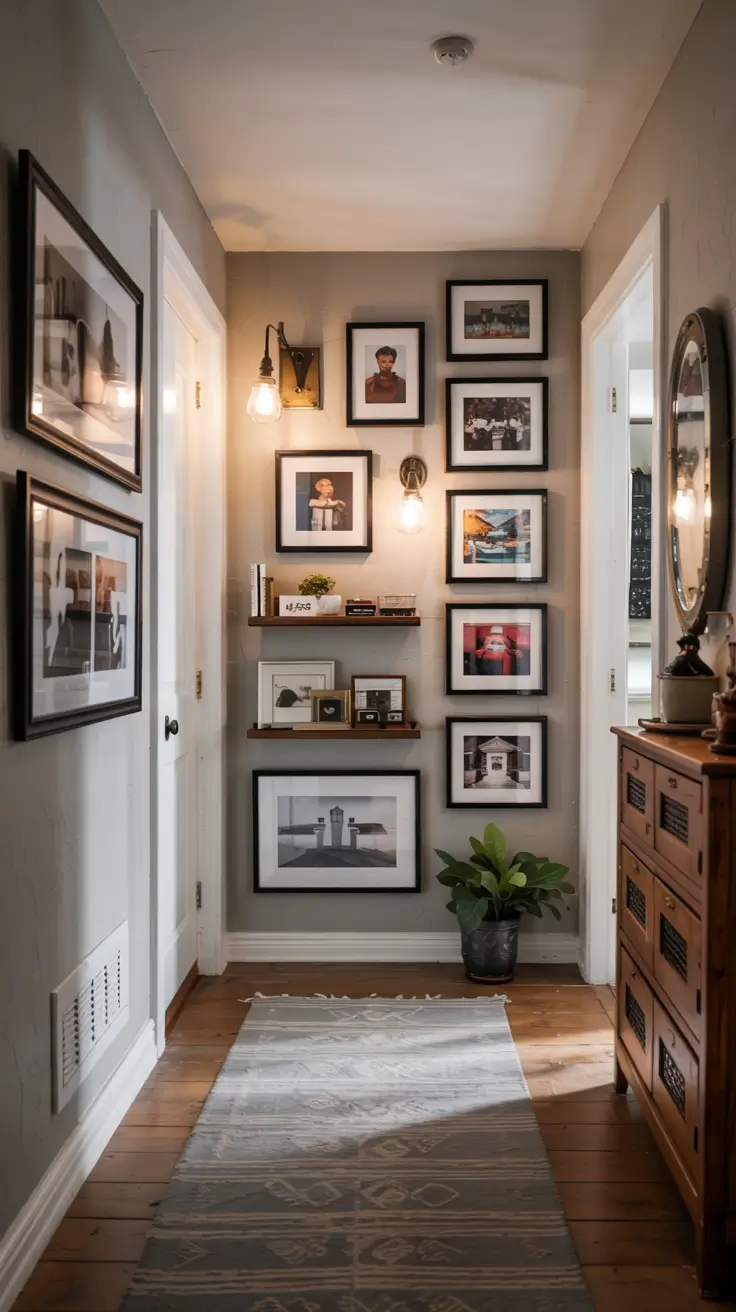
To make the space look nice, I enjoy hanging matching gallery walls either with family pictures or travel photography or simply a print with a similar color scheme and frame pattern. It is also great in busy homes because sometimes I lay picture ledges up one wall to allow art to be stacked on and replaced without holes. Another popular tool is wall sconces, as they allow indirect light and can be fitted between frames to introduce rhythm and coziness. I incorporate built-in shelves or shallow wall niches in certain projects in order to display books or pottery or plants without using up space in the walkway. All ornamental details of an upstairs corridor wall must seem purposeful and not dangerous.
I think the best upstairs corridor is a transitional space between a public and a private life, not a gallery that has to struggle with bedrooms. I prefer the system that is recommended by most American interior stylists and suggests using the same material, like black frames or shelves made of light oak, in order to gain the impression of order. By practising this rule, even a long run of wall having several doors can appear to be harmonious instead of cluttered. I also give consideration to the way the decor reads at the top of the stairs as that is usually the first thing visitors will see of the Upstairs area.
The additional feature that I would add to the walls of the upstairs hallway, which is functional, would be a small wall-mounted mirror or a small message board, particularly in houses where the landing is a small homework or reading place. A narrow console and a lamp could be put in a larger area but in narrow corridors I will use a vertical solution such as peg rails or hooks on the outside of kids rooms to hang robes and bags. Combining practical items with art will allow me to make sure that the upstairs hallway is not vacant and functional.
18. Combining Functionality And Aesthetics In Hallway Bathrooms
The ideas of hallway bathroom remodel are on the border of utility and style as these small rooms are used not only by the daily routine but also by the guests. In updating a bathroom that opens onto a main or Upstairs hallway, I attempt to ensure that it does not appear to belong to a different design world, but to one that is visually related to the corridor. I tend to duplicate a interior color or material in the bathroom, like extending the same floor tile or wall paint to the bathroom. This technique induces a faint air of continuity at every time the door is open which it frequently is in the real world. My vision in the future of the hallway remodeling concepts in 2026 is that the focus is more on these bathrooms being used as jewel boxes that match the rest of the corridor.
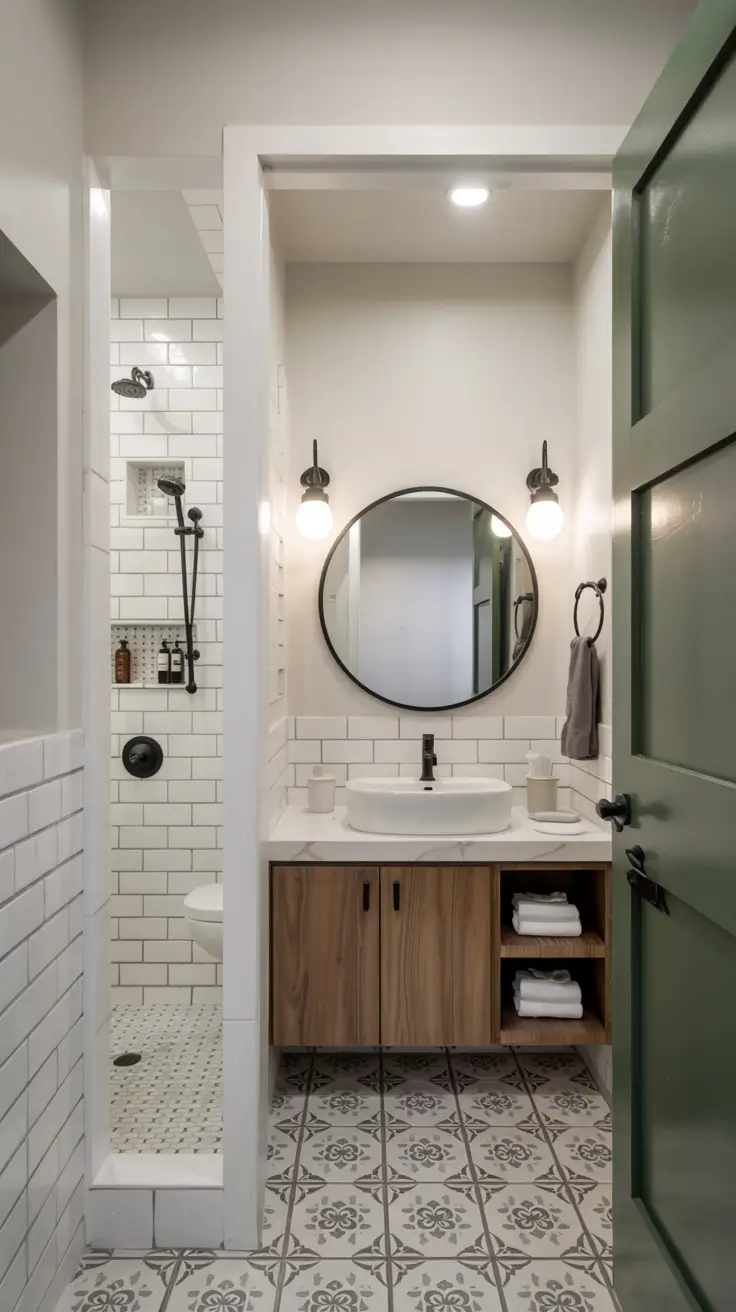
I concentrate on a small set of fixtures and clever storage, which make the space in a hallway bathroom look clean and inviting. I usually request a wall-mounted vanity or a pedestal sink to clear up floor area, accompanied by recessed medicine cabinets or mirrored cabinets over them to store things out of sight. Lighting plays an important role, thus I prefer to apply a mixture of the ceiling lights as well as sconces around the mirror to secure flattering shadows free light. The selected tile can also be important: I can have a plain subway tile applied in a new design (vertical stack or herringbone) so that the room does not look saturated with tiles, but creates an impression of a modern design. In case the hallway is patterned, I balance it by having simpler finishes in the bathroom to make it not a visual noise.
In my opinion, a bathroom in a hallway is a perfect location to add more accent color or specialty material, provided that it matches with the corridor. A range of American design magazines suggest that powder rooms should be used as a trial ground where wallpaper, strong color paint, or dramatic fixtures can be put to the test. I adhere to that piece of advice by frequently choosing a distinct faucet finish or a statement mirror to these rooms, so that when you open the door to the hall, there is something to look forward to. When guests go to the bathroom I would like to see them feel that they have found a well-thought-out, well-designed corner instead of a strictly utilitarian one.
What I tend to include in the list of hallway bathroom remodeling ideas is how the door and the sightlines will react with the hallway. I may use a pocket door or one that swings in such a manner that it does not obstruct passages through narrow corridors. I also prefer centering the key focus, which is the mirror or a work of art, with the image in the hallway to make even a brief look inside the house seem organized. By aligning these details with ideas of remodelling closets in the hallway and adjacent storage, I can bring about the feeling of the bathroom being part and parcel of the entire design instead of the piece with a nail.
19. Compact Design Strategies For Small Hallway Transformations
Working on small hallway remodel ideas I approach each inch as a resource that has to be utilized delicately. Small areas or corridors around an entrance may seem claustrophobic, yet, when properly designed and furnished, may serve as useful and pleasant spaces. I begin by reducing the visual space: reducing the amount of finishes, using lighter colors, and avoiding any obstacles on the floor. My top priorities in the context of hallway remodel ideas 2026 include clean-lined millwork, a combination of lighting, and thin storage respecting the circulation. This is always aimed at creating more space in such a small space without losing functionality.
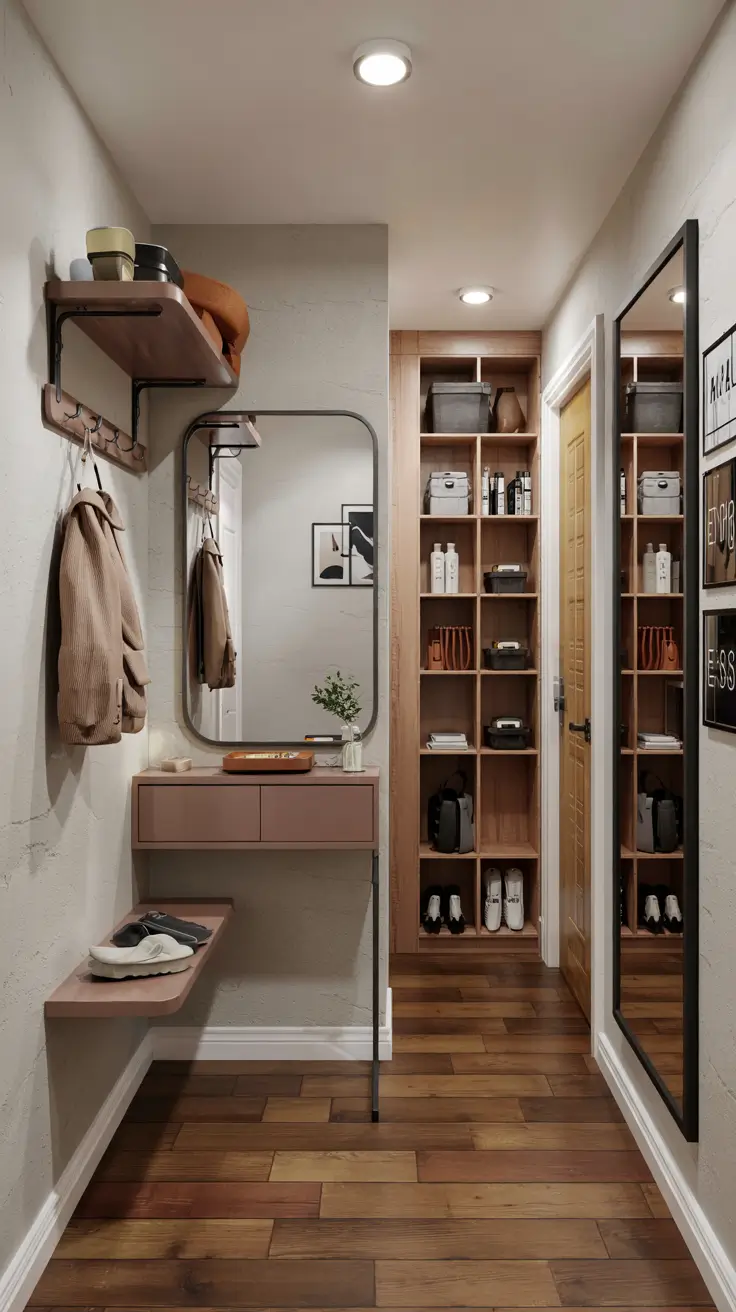
On small corridors, I use built-in products extensively to store objects not on the ground. Ms. Shallower remodel ideas, including converting a deep closet into a series of open shelves with baskets and hooks, can radically enhance utilization. My favorite are wall mounted shelves, peg rails and narrow console tables which are not more than a few inches deep and allow people to move around easily. Mirrors are imperative; I tend to have a full-length or big horizontal mirror in front of an area of light to reflect and make people see that the area is expanded. The selection of the door styles is even important and I at times instruct sliding or pocket doors in too tight spaces to free some floor space that would have been occupied by door swings.
Small hallways in my experience are the places where restraint should be exercised more than any other section of the home. I concur with most design gurus who say that disorder is the bane of comfort in tight places, and hence I would designate a place to keep shoes, coats, and bags during the developmental design. I also consider the ceiling height and tend to employ the upward-moving objects, e.g., tall coat hooks or long, low bookcase, to bring the eye up. With the help of framing the small hallway as a carefully curated space, I am able to make it feel deliberate instead of compromised.
The lighting and better wayfinding is what I would mostly like to add to small hallway designs. I may indicate several smaller lights along the ceiling rather than one in the middle, producing even light without obnoxious shadows. I also prefer making slight variations in the floor pattern or wall color to indicate transition between entry, hallway and living places. A combination of these strategies will help me to turn a small passage into an effective connector that does not create noise and helps to maintain everyday routine.
20. Trending Color Palettes For 2026 Hallway Remodels
When I consider the color in the context of the idea of hallway remodel 2026, I envision a move towards the warm and nature-inspired colors that are both welcoming and sophisticated. The corridors are the perfect spots to experiment with these colors as they are touching so many rooms and may connect various styles. I tend to lean towards warm whites, soft greeries and clay colors and muted greens that will blend into both traditional and modern structures. These colors make corridors cozy, particularly in already patterned and colorful living rooms. The palette of the hallway should be set first so I can create a unified story that supports all the branches of it.
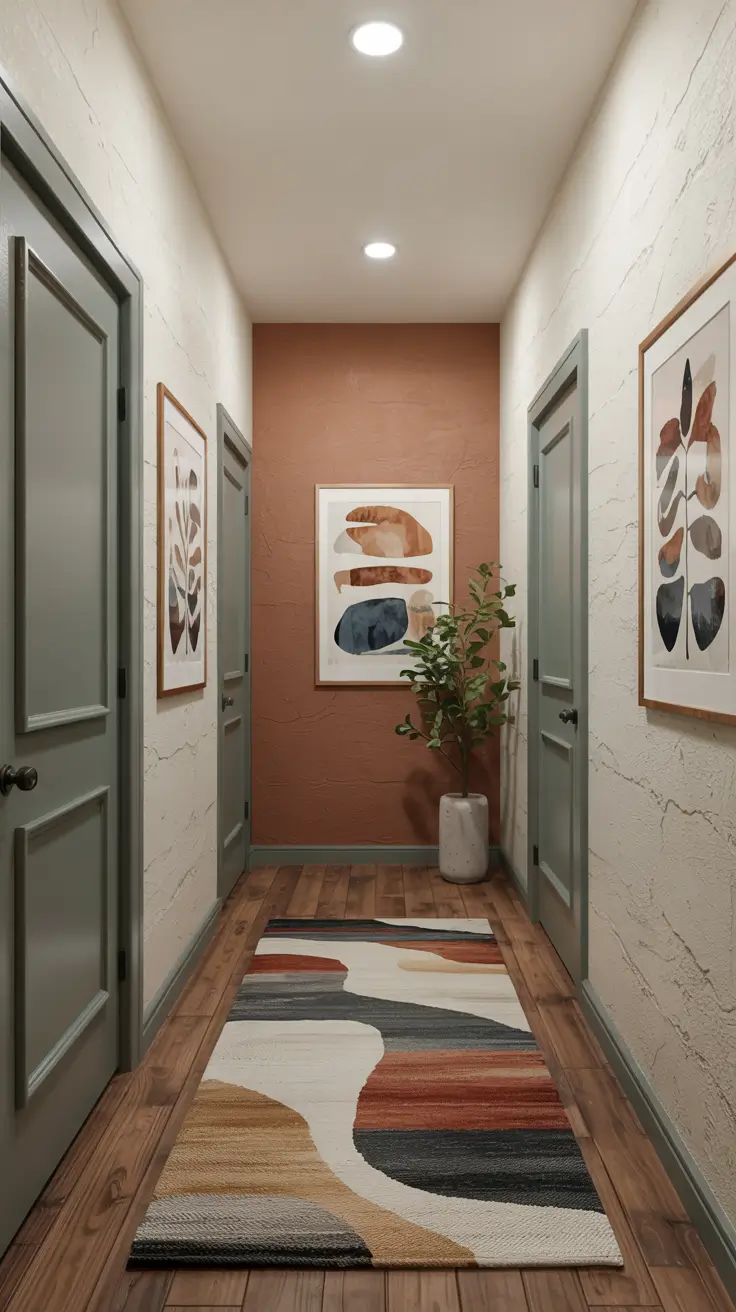
In more daring endeavors, I prefer to add darker shades strategically, particularly at the end of a hallway, or at the doorframes. A dark green, navy or deep aubergine color can make a plain wall work a point of interest to go to. I occasionally paint the interior doors in contrast color and keep the walls plain, this gives character without cluttering the area. I prefer warm undertones in the colors I pick in the corridors (Upstairs and below) that have less natural lighting so that they do not make them feel cold. The use of trim and ceiling color is equally important and I usually reduce the contrast by using off-white rather than pure white.
To me, the hallways must convey the whole atmosphere of the house and not be imitating every fad, however, it is always good to understand what is on the trend. Earthly neutrals, desaturated blues and greens, sun-warmed terracotta colors that are easy to match with wood, stone, and metals are featured in many U.S. color predictions. When I use these predictions on hallways, I look at how they will interact with the already existing objects such as flooring and doors as they may prove to be costly to change. I want a palette to be classic but pays tribute to what is in the present.
To a color scheme that I usually include is a simple three color rule of the hallway; one primary wall color, one trim and door color, and one accent color, that is used in smaller quantities or in artwork and textiles. Following this structure, I am able to prevent a patchwork effect in case a variety of rooms open on the same hall. This framework also allows integrating bold decisions in the surrounding spaces without making the corridor overly hectic.
21. Complete Hallway Remodel Guide: From Planning To Perfection
Whenever I am dealing with a full hallway remodel, I will approach the area as any other room, beginning with a clear plan instead of going directly to the paint or decoration. I start with evaluating the traffic flows, storage requirements, light, and the connection of the hallway and the other rooms. This will assist me to choose between flooring upgrades, new lighting, hallway closet remodel ideas or any of the three. In the bigger context of the hallway remodel ideas 2026, I do believe that strategic planning can be expected to produce superior outcomes compared to hasty upgrades. A planned corridor is comfortable, functional, and aesthetically related to the rest of the house.
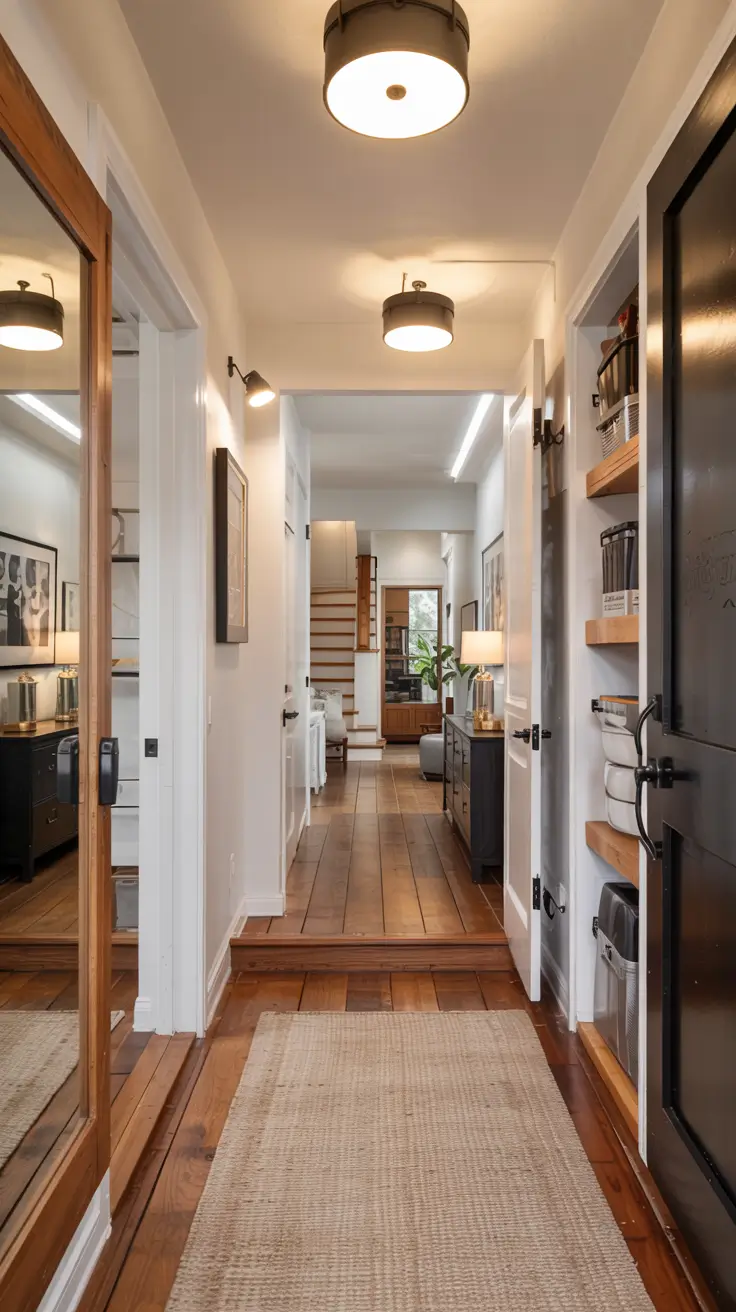
I would plan my next action by making a simple list of ideas to be improved, the first one being structural alteration and the last being style. It may be to take care of flooring and baseboards, doors and hardware, lighting, paint, and lastly art and accessories. I think about the practical aspects like where shoes, coats and bags will reside, and I usually incorporate built-in solutions to ensure clutter is not present. In the event that a corridor is opened to a bathroom or closet in the hallway, I will ensure that I do those upgrades simultaneously so that the materials and colors can be compatible. Through such hierarchy, I will be able to ensure that the remodel does not appear fragmented.
Attention to small details is what makes a polished hallway and a basic one in my experience. I am careful with the placement of light switches, thermostats, and vents and in most cases attempt to position them in a manner that makes them look as though they were made to fit or to hide them. Homeowners are often advised by the design professionals to invest in good hardware and lighting since these are the things you touch on day to day and I concur. Replacement of door handles, hinges, and light fixtures will instantly decorate the space without necessarily gutting the entire area. These are what give a completed hallway a perceived completeness when I pass through it.
My favorite finishing touch to any remodel I do on a hallway is a final sweeping touch, when I reposition the artwork and replace the runners and make light selections during the daytime and evening hours. I also use a diffuser or a small plant in a safe corner to make the corridor seem alive. In the case of the Upstairs areas, I might incorporate a small reading corner with a chair and lamp where there is room as a comfort factor in the practical design. This final review step will allow me to notice anything that does not feel right and make the hallway look as more than merely updated.